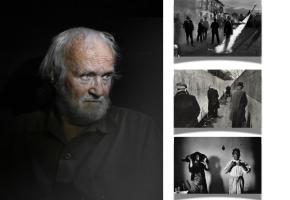




















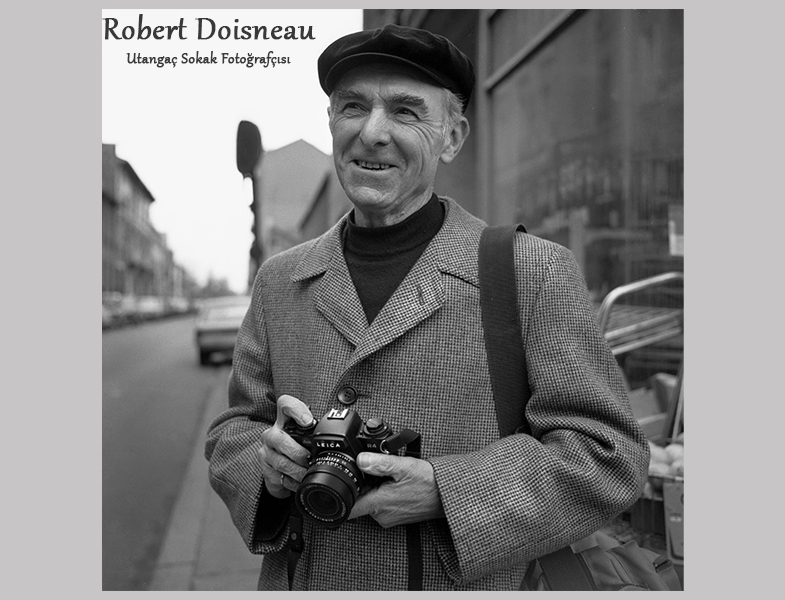
French photographer Robert Doisneau is best known for his photographs of Parisian street life. The most famous of his impressive photographs, in which he captures the romance of old Paris and the naturalness of daily life, is his photograph titled "Le Baiser de l'Hôtel de Ville" (The Kiss in the Municipality Hotel).













Text: Şahinder ÖNDER FİŞENK
Early
Robert Doisneau was born on April 14, 1912 in Gentilly, a suburb of Paris. When little Robert was four years old, his father, a plumber, died in the First World War. Robert lost his mother when he was seven years old. He was raised by a loveless and uncaring aunt.At the age of thirteen, he entered the arts and crafts school called École Estienne. His first contact with art was here. He took still life and figure drawing lessons. He graduated in 1929 with a diploma in lithography and engraving.He started photography as an amateur when he was given a camera as a gift at the age of sixteen. His aim was to improve his painting skills. At first, he was taking pictures of paving stones because he was extremely shy. However, later on, he struggled with his shyness and started taking photographs of children first, and then gradually of adults. Doisneau took a job at Atelier Ullmann in 1930. This was a graphics studio specializing in pharmaceutical industry advertising. At first he worked as a letter designer. But then he became a camera assistant, then a staff photographer.
Professional Life
Leaving the studio in 1931, Doisneau took a job as an assistant to modernist photographer André Vigneau. In this studio, he met artists and writers with avant-garde (pioneering) ideas. Doisneau had entered the art community. In 1932, he sold his first photo story to Excelsior Magazine.
Doisneau met Pierrette Chaumaison while cycling on holiday in a village in 1934. In the same year, he started working as an industrial advertising photographer at the Renault car factory in Boulogne-Billancourt.Working at Renault contributed significantly to the development of Doisneau's photography. It also helped him overcome his shyness towards people. Robert and Pierrette married in 1936.The couple had two daughters, Annette and Francine.Annette worked as his assistant until her death in 1979.
Doisneau, after working at Renault for five years, was fired in 1939 for being constantly late.To make a living he had to try freelance advertising, engraving and postcard photography.In those years, the French postcard industry was the largest in Europe, with postcards used as both greeting cards and holiday souvenirs.
Shortly after, Charles Rado hired Doisneau at his Rapho Agency. He had to travel around France in search of photographic stories.This is how he took his first street photographs professionally.
Doisneau worked at the Rapho Agency until the outbreak of World War II. Due to the war, the French army drafted him into the army as a photographer and soldier. While photographing the resistance during the German occupation, he also actively served in the French resistance with fake IDs and passports, using his draftsmanship, calligraphy and engraving skills.
Post-War
Doisneau photographed the occupation of Paris as well as its post-war liberation. However, unlike others, Doisneau did not want to show situations in which the people he photographed were humiliated. That's why he didn't take pictures of women who had their heads shaved and were exposed on the streets as punishment for sleeping with German men.
Immediately after the war, he returned to freelance photography for leading international magazines such as Life Magazine. He focused on capturing the daily life of Parisians. He also took his most famous photograph, “Le Baiser de L'Hôtel de Ville” (The Kiss), for Life Magazine in Paris at that time. This photo would subsequently remain at the center of a legal and financial dispute that lasted for years.
Shortly after, he joined Alliance Photography Agency. Then, in 1946, Rado hired him again at his Rapho Agency.Although he received an invitation from Henri Cartier-Bresson to join Magnum, he remained with the agency throughout his working life.
In 1948, he signed a contract with Vogue to work as a fashion photographer. Editors believed he would bring a fresher, more casual look to the magazine, but Doisneau did not enjoy photographing beautiful women in elegant surroundings.He escaped from the studios and preferred to take photographs on the streets of Paris.
Doisneau joined a group called Le Groupe des XV in 1950. The group was founded in Paris in 1946 to promote photography as an art and to draw attention to the preservation of the French photographic heritage. Here Doisneau studied with Rene-Jacques, Willy Ronis and Pierre Jahan. However, after a while the group disbanded. Doisneau then joined another group, less exclusive and more militant, called Les 30 x 40 Club Photographique de Paris.
Latest Period
The 1950s were Doisneau's peak. It can be said that the 1960s were more stable. By the 1970s, a change had begun in Europe. The editors were looking for interviews and works that could depict the modern social age.Old style photography was being replaced by new styles, magazines were being sold off, and television was becoming the new hero.Despite all these changes in the media, Doisneau continued to work.He turned to portrait photography commercially. He took portraits of famous people, including Jean Cocteau, Pablo Picasso, George Braque, Alberto Giacometti and Ferman Léger.He also produced books for children. He worked with writers and poets such as Blaise Cendrars and Jacques Prévert.
Robert Doisneau was a prolific artist who worked until his death in 1994, with many books and many national and international awards. Doisneau, who was extremely modest throughout his professional life and did most of his work himself, would also turn down the astronomical fees offered to him. After his death, Doisneau's photographs of Parisian social life came to the fore again. He became the photographer whose photographs were most used in places such as advertisements and calendars.
Photography
Doisneau has become an icon of the photography world thanks to the photographs he produces with his ability to transform ordinary moments into extraordinary images. He captured the essence of daily life in Paris in his photographs. Unlike the photographs of many contemporary photographers, his photographs do not serve popular culture or as tourist guide images to Paris; Rather, it is filled with ironic, playful and modest images of socialization between classes and the playful juxtaposition of eccentrics in the streets and cafes of modern Paris. The shyness and modesty in his character are also reflected in his works.
Robert Doisneau was particularly interested in photographs that had a humorous aspect, inspired empathy, and included scenes of ordinary people's daily life. This allowed him to capture images that had a strong connection with the viewer.
Doisneau mostly used natural light, which added depth and originality to his photographs. He also preferred to use black and white film because he thought it conveyed the atmosphere and emotions of the scenes he captured better.
Influenced by Henri Cartier-Bresson, Doisneau approached street photography in a similar way to his, and carried out his work with Bresson's "moment of decision" principle. He has eyed the perfect moment when all the elements within the frame come together to create an intriguing image.
Robert Doisneau continues to be an inspiration and role model for many photographers today. He is an artist whose works are well known and used around the world. In particular, the photograph “Le Baiser de L'Hôtel de Ville” (The Kiss) has remained in memories as a symbol of love and romance.