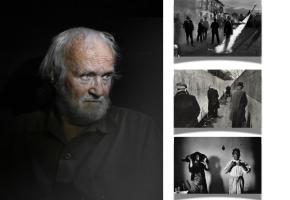





















This is the life story of a photographer who reflects the perspective he gained through war, homelessness and ultimately immigration experiences into his art.













Text: Şahinder ÖNDER FİŞENK
EARLY YEARS
Robert Frank was born in Zurich, Switzerland, in 1924. His father, Hermann Frank, from Frankfurt, was a successful and well-educated Jewish businessman who was also an art-loving amateur photographer. Basel's mother, Regina, was the daughter of a wealthy manufacturer. Frank also had an older brother. In 1935, during the rise of the Nazis, the Frank Family, like many other Jewish families, were stripped of their German citizenship and their passports were cancelled. Thereupon, the family became stateless and applied for Swiss citizenship.Young Robert was waiting with his family in Switzerland for the end of the horrors of World War II. Meanwhile, after graduating from high school in 1941, he became interested in photography. He became an apprentice to photographer and retoucher Hermann Segesser, who lived in the same apartment building.The following year he began working for Zurich commercial photographer Michael Wolgensinger, who introduced him to Switzerland's active magazine, newspaper and book publishing industry.In 1944 he became Victor Bouverat's assistant in Geneva. Frank, who received extensive training here, published his first hand-bound photography book, 40 Fotos, in 1946. Although he had only been photographing for five years, the book covered a wide range of exceptionally masterful photographic styles. The photographs, which used Bauhaus-inspired light and form, were a precursor to Frank's future work. A new master of photography was being born!
IMMIGRATION TO AMERICA
Although Switzerland was a safe place during the Second World War, Frank also experienced some restrictions there due to the influence and threat of Nazism. Therefore, he left Switzerland in 1947 and emigrated to the United States.Shortly after arriving in New York, he was hired by Alexey Brodovitch, the legendary art director of Harper's Bazaar.Although inspired by Brodovitch's innovative teachings, he found the atmosphere at the magazine stifling.He left the job in late 1947.
Frank made several trips during his first few years living in the United States. He went to Central and South America in 1948; He briefly visited Cuba, Panama, Brazil and Bolivia before traveling and photographing in Peru. At the end of this trip, he published a spiral-bound book called "Peru" containing 39 photographs.
traveled to Europe in 1949, shortly after meeting artist Mary Lockspeiser. His goal was to live in Paris by the end of the year. However, he first went to Switzerland to see his family. There he prepared a unique book of 74 photographs, Mary's Book, dedicated to Mary, whom he would marry the following year. During this European trip, he also traveled and photographed in Spain and Italy.
Returning to the USA in 1950, Frank met Edward Steichen and participated in the "51 American Photographers" exhibition held at the Museum of Modern Art in New York. Shortly after, he married Mary. After the birth of their son Pablo in February 1951, Robert and Mary returned to Europe for a two-year period. This time they stayed in Paris, London, Zurich, Wales and Spain. Frank focused on elements that expressed the character of the places he visited. He photographed bullfights in Valencia, bankers in London, flowers, chairs and street vendors in Paris.
In 1952, he made a handmade book called Black White and Things. In the introduction of the book, which consists of 72 photographs and is divided into three parts, he included a short quote from Antoine de Saint-Exupéry: "One can only see correctly with the heart; the essential cannot be seen with the eye."This quote was a summary of Frank's outlook on life and photography.
Frank returned to New York in March 1953; McCall's continued to work as a freelance photojournalist for magazines such as Vogue and Fortune. He met contemporary photographers such as Saul Leiter and Diane Arbus. He helped found what Jane Livingston called the New York School of Photography.
Meanwhile, Mary gave birth to their daughter Andrea in April 1954. Frank, who settled in America and now has a family with two children, could not adapt to the fast pace of American life and the social structure that placed excessive emphasis on money. He saw America as a tough place. He was frustrated that his photographs were not published more widely.
Participated in The Family of Men exhibition, organized by Edward Steichen at the Museum of Modern Art (MoMA) in 1955 and seen by 9 million visitors, with 7 photographs. This number was higher than most other contributors. It gained further recognition due to its inclusion in this exhibition and the catalog printed thereafter.
THE AMERICANS
In the fall of 1954, he applied for a fellowship from the John Simon Guggenheim Memorial Foundation to, as he wrote in his application, “to photograph freely in the United States and to record American society.”With letters of recommendation from photographer Walker Evans as well as Steichen and Brodovitch, he won a scholarship in the spring of 1955 and was rewarded with a trip across the United States.For the first time in his life, Frank was traveling around the United States taking photographs, passing through places like Detroit, Dearborn, Michigan, Miami, New Orleans, Houston, Los Angeles, and Chicago.There was no set itinerary. He took his family with him and they spent the next two years on the road. Frank went on a 16,000-kilometer journey with 760 reels of film and returned with 28,000 frames of photographs.
From these photographs, Frank selected 83 iconic frames in black and white. With these, in November 1958, in France under the name "Les Américains"; In 1959, he published a book called The Americans in the USA, with a foreword by Jack Kerouac, the famous Beat Generation Author of the period. Nothing in the world of photography would ever be the same again. With this cult work, one of the most detailed and honest analyzes of US society to date, Frank laid the foundations of a great and important tradition that would be followed by the great masters of contemporary American photography such as Mary Ellen Mark, Elliot Erwitt, and Diane Arbus.
In the four-part book, Frank captured the American people, black and white, military and civilian, urban and rural, poor and middle class, meeting in pharmacies and restaurants, on city streets, mourning at funerals, and gathering in or around cars. With his piercing vision, poetic insight, and distinct photographic style, Frank revealed the politics, alienation, power, and injustice just beneath the surface of the country. The photographs in its content were far from the healthy, simple photographs seen in popular magazines of the period. Jack Kerouac said in the foreword of the book, "After seeing these photographs, you will not know which is sadder, a music box or a coffin."
FROM THE BUS
In the summer of 1958, a few months before The Americans made its debut in France, Frank began experimenting with moving images. But before turning wholeheartedly into filmmaking, he made another photo series called From the Bus.After the unique freedom of the “Americans” project, Frank this time greatly restricted his perspective by taking his photographs from the window of a moving New York city bus. Capturing pedestrians while walking, waiting, and sometimes in motion, these photographs bridged the gap between still and moving photographs and were perfect examples of snapshot aesthetics.
START IN CINEMA
Following the From The Bus project, Frank quickly began producing films. He believed that great artists should never repeat themselves and found a new form of expression in filmmaking. Entering the film industry marked a major shift in Robert's career.His first film was the 1959 film Pull My Daisy, written by Kerouac. People from the famous Beat circle, such as Allen Ginsberg, Gregory Corso, Peter Orlovsky, appeared as actors in the film.
In total, he made approximately thirty avant-garde films of various lengths throughout his life, with subsequent films such as The Sin of Jesus and Me And My Brother. However, his most sensational film was the documentary he made under the name Cocksucker Blues, which contained corrupt footage of the Rolling Stones on tour.
NOVA SCOTIA AND BACK TO PHOTO
In 1963, Frank became a United States citizen. But over the following decade, he began spending more time in Canada. After separating from Mary in 1969, he bought a house in Mabou on Cape Breton Island, Nova Scotia, with artist June Leaf in 1970. "I ran away to Nova Scotia. I just wanted to be alone. That's what I wanted after the Cocksucker Blues fiasco," he said. He and Leaf were married in 1975.
After moving here, Frank began to experience some misfortunes in his life. First, his friend and partner Danny Seymour disappeared while sailing to South America. While his daughter Andrea died in a plane crash in Tikal, Guatemala, his son Pablo was first hospitalized and then diagnosed with schizophrenia.After all this, Frank adopted a reclusive lifestyle; Although he remained interested in film and video, he returned to photography and published his second photography book, The Lines of My Hand, in 1972. This work consisted largely of personal photographs, and so his book has been described as a “visual autobiography.”
Although he continued to move between Mabou and New York, Frank continued to switch between filmmaking and different photographic formats and experiment with the theme of autobiography without much consideration, claiming that “the style of reportage photography is old and there is no point in it anymore.” In 1974 he began experimenting with a Polaroid camera. In 1975, he began making collages using machine-made color prints on photographs he took with a Lure camera, a cheap plastic camera loaded with color film.
LAST YEARS
During these years Frank frequently printed multiple negatives on a single sheet of paper. Using tape, glue, and even nails, he combined multiple prints into a single work of art. He further desecrated the image by drawing the text on his negatives and writing it in bold, sometimes crude letters on his prints. His photographs became intensely personal.
He had an exhibition called 'Robert Frank: Coming Out' at the National Gallery of Art in 1994. In 1995, he founded the Andrea Frank Foundation, which provides scholarships to artists in memory of his daughter.
Although he was generally ambivalent about awards after the exhibition "Robert Frank Storylines" exhibited at Tate Modern in 2004, he went to Europe in 2004 to receive the prestigious Roswitha Haftmann Prize.
Frank, who lost his son in 1995, preferred a more introverted life. Many refused interviews to avoid public exposure. He didn't take on much work other than directing music videos for some artists or photography work that was important to him. Frank died on September 9, 2019, at the Inverness Consolidated Memorial Hospital on Cape Breton Island, Nova Scotia, at the age of 94.
PHOTOGRAPHY
Robert Frank has produced many works in the field of motion and still images throughout his long career. However, his most successful work was undoubtedly The Americans project. Frank acted like a foreign voyeur in a country not his own, unobtrusively capturing the tensions of the United States' geographic, economic, racial, and religious diversity. This project, which is unique in content and form, has been and continues to be an inspiration to many photographers around the world. In the introduction to the US edition of the book, published in 1959, Kerouac writes, "Frank has milked a sad poem from America" with 83 photographs.
The war, homelessness and eventually immigration that Robert Frank experienced in his early youth affected his personality and art, and in his own words, he "sympathized with people who were struggling." He also had a distrust of people who set the rules. This is clearly evident in his works.
The Beat philosophy he adopted in the first years of his settlement in the USA is based on journeys and displacements. The road is the symbol of the endless search. Zen, the philosophical essence of the Beat Generation, is based on finding the meaning. For this generation, the important thing is the 'journey itself' rather than arriving at a place. Robert Frank also lived his life and practiced his art in line with this philosophy. He captured both the outside and the ordinary and never let anything stand in the way of his art.
Called the "Man of New Photography" by New Yorker Magazine Critic Janet Malcom, Frank is also considered the father of the 'snapshot aesthetics'.
Frank has accomplished some very unusual and successful works in cinema as well as in photography, as he has brought many of his candid photography habits into the world of cinema. Due to his experience in illuminating the objects in front of his camera and his different perspective, the films he made became true phenomena of their time. Robert Frank, one of the most influential photographers of the 20th century, continues to influence the new generation of photographers with his lifestyle, philosophy and different perspective.