



















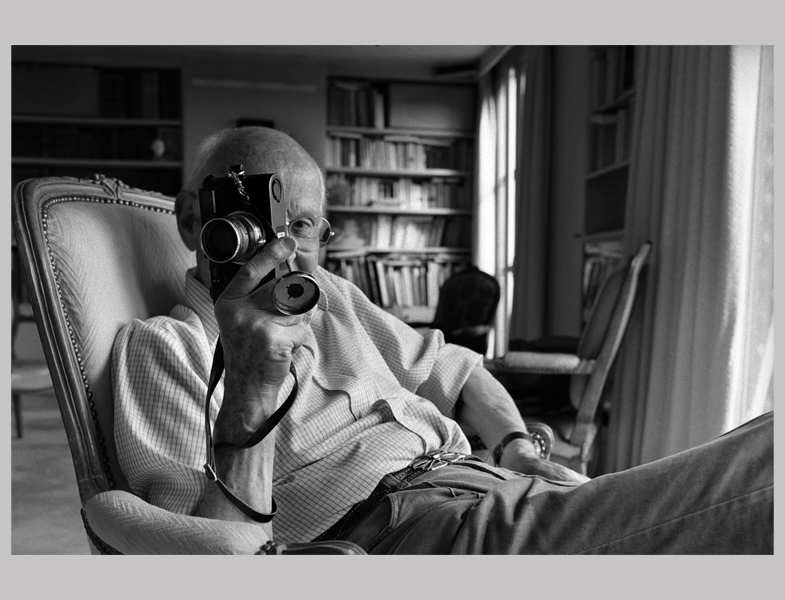
"Taking photographs means aligning one's mind, eyes and heart. It is a way of life."













Henri Cartier-Bresson, one of the founders of Magnum Photos, who pursued reality with an emphasis on the 'critical moment' in photography, fell into a lifelong passion for photography with his Leica camera, after he nearly died due to the disease he caught in the Ivory Coast in 1932. He pursues people and realism...
Compiled by: Nihan ÖZGEN
Henri Cartier – Bresson certainly had a genetic visual talent! Because he stated in an interview that his father draws very well. His brother was a promising painter, but he was killed at the beginning of World War I, and because of this, Bresson was attracted to painting in his early youth and studied painting with his brother's friends. And afterwards, for two years (1927-1928), he continued to study painting in the workshop of André Lhote, a Cubist painter and also a good teacher. After a while, he left the painter because he was worried that his works would resemble Lhote's paintings.
Bresson, who did not care much about his family's wealth, caught malaria in the Ivory Coast, where he went with limited money, at the age of 23, nearly died, and left Africa, never to return again. This event became his turning point, and thanks to a Leica he discovered, he pursued the new drawing method, photography, which instantly carves and shapes reality like a sculptor. In fact, he plays games with the 'act of looking', which is valid for both drawing and photography.
Now his lifelong passion with the 50 mm Leica had begun. He was capturing hard-to-see objects with his small lens. In 1933 he had his first exhibition at the Julien Levy Gallery in New York. He later made films with Jean Renoir.
He was taken as a prisoner of war in 1940, escaped from the Nazi Camp on his third attempt in 1943, and then joined an underground organization to help prisoners and escapees. In 1945, he photographed the liberation of Paris with a group of professional journalists and then shot the documentary Le Retour.
In 1947, he founded Magnum Photos with Robert Capa, George Rodger, David Seymour (Chim) and William Vandivert. After traveling in the east for three years, he returned to Europe in 1952 and published his first book, Images à la Sauvette (The Decisive Moment).
From 1968 he began to restrict his photographic activities, preferring to focus on drawing and painting. In 2003, with his wife and daughter, he founded the Fondation Henri Cartier-Bresson in Paris to preserve his works. Cartier-Bresson, who received an extraordinary number of awards and an honorary doctorate, died at his home in Provence on August 3, 2004, a few weeks shy of his 96th birthday.
“Magnum is a community of thought, a shared human quality, curiosity about what is happening in the world, respect for what is, a desire for visual adaptation.”
Photography
He expresses his approach to photography with these sentences: "For me, the camera is a sketchbook, a tool of intuition and spontaneity, the master of the moment that visually questions and decides at the same time. To give meaning to the world, the one who looks through the frame must feel himself in it. This stance requires focus, mental discipline, sensitivity and a sense of geometry. Simplicity of expression is achieved with great economy. One should always take photographs with great respect for both the subject and oneself."
Throughout his photography career, he always remained loyal to 35mm and carried his Leica with him, which he described as 'an extension of his eye'. He provided photographs to important agencies and magazines, thus getting the chance to travel the world. Following his book 'The Decisive Moment', which had an important place in his professional life, his retrospective exhibition of 400 prints went on a tour of America in 1960.
Having worked as a photojournalist for many years, he is used to describing what he sees in a single striking frame. His knowledge of journalism very well and his understanding of the role of photography in social interaction made his works unique. Although some critics say that he is just a 'snapshot' or 'point-and-shoot' photographer; Its superior use of light, shadows, human emotions and characters goes far beyond point-and-shoot photographs!
Human details have a very important place in each of his photographs and realism is indispensable. Still, it does not give up on romance and continues to surprise its audience.
He took his photographs with manual cameras with 35mm and 50mm lenses, and rarely used zoom lenses in nature shots.
He also expressed his ideas about photography education. In all schools; He thought that a visual education should be given just like literature, history and mathematics, and stated that he found it appropriate to learn visual grammar in photography, just as grammar is learned in a foreign language. Because according to him, the content of the photo; It supports the sense of rhythm, shapes and tones.
According to Bresson, thinking is a process that should take place before and after taking the photo. It should never be considered when taking photographs. Success depends on the person's general cultural level, value judgments, clarity and liveliness of mind. The danger to be feared most is; These are things that are artificial and contrary to life.
Master photographer who took photographs for nearly half a century; Thanks to his realistic, powerful and original compositions, he left deep traces in the history of photography.