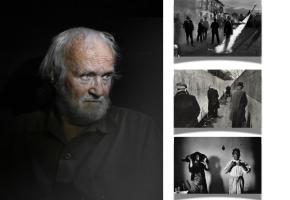





















André Kertész (1894 – 1985) is considered one of the best photographers of the 20th century. With a photography career spanning over 70 years, Kertész has been influential in photojournalism and the art of photography.













Unfortunately, the photographer, who never achieved the fame he deserved for most of his life, became internationally popular after retiring at the age of 68.
Prepared by: Nihan ÖZGEN
After graduating from the Hungarian Commercial Academy, André Kertész, one of the most influential photographers of the 1900s, started working as a clerk at the Budapest Stock Exchange. Other than the financial resources he needed to purchase his first camera, he had no plans for a career in the stock market. Even though he was only 20 years old, when he was drafted into the Austro-Hungarian army in 1914, he had already begun to show his maturity in photography... The photographs he took during the war gave the signals that he would become a serious artist. Unlike other war photographs, Kertész's frames were like soldiers' diaries. Part of Kertész's genius was his ability to draw attention to seemingly 'insignificant' images.
He sold a small amount of photographs to Hungarian magazines, but this money was not enough to make a living. Desperate, he turned to the stock market and continued to work there until 1925. During this period he met his wife Elizabeth. Kertész, who worked at the stock exchange during the day, dealt with photography in his remaining time.
|
Portrayed throughout his career as a soldier working behind the scenes of photography, Kertész spent his life in an endless search for recognition and fame, and despite receiving numerous awards for photography, he never felt that both his style and his work were accepted by critics and art audiences alike. |
He was always chasing better financial opportunities. In 1925, he left his mother, two brothers and fiancée Elizabeth behind and started living in Paris to earn more money. Having worked for dozens of different European magazines, Kertesz found Paris to be a welcoming and artistically inspiring place. In a short time, he met great artists living in Paris, such as Piet Mondrian, Marc Chagall, Alexander Calder, Constantin Brancusi, Sergei Eisenstein and Tristan Tzara. He managed to publish some of his work in journals from several European countries. He was the first photographer to open a personal exhibition in Paris in 1927.
He married Elizabeth shortly after his mother's death in 1933. In 1936, he signed an agreement with the Keyston Agency and settled in New York with his wife. For almost twenty years, no one in America paid any attention to his talent in photography. Until, in 1964, John Szarkowski, Curator of the New York Museum of Modern Art, organized Kertész's exhibition, which would have a great impact. In the following years (1970-1980), his photographs were exhibited in various parts of the world and received many awards!
He not only pioneered street photography, but also had a strong influence on a generation of photographers, including Henri Cartier-Bresson. When asked about Kertész, Bresson said: "We all owe something to Kertész. Whatever we did, Kertész did it first." He showed his respect by saying. Another famous photographer, Brassai, beautifully captured what made Kertész so great as a photographer:
“André Kertész has the two qualities necessary to be a great photographer: an insatiable curiosity about the world, people and life, and a keen sense of form.”
The photographer, who pursued color photography since the mid-50s, approached color photography simply and rejected all kinds of color play. Books were published one after the other. After his wife's death in 1977, he started to never leave his house. He took his photographs from the window of his house.Kertész, who wanted to preserve his works before he died, donated all his negatives and personal documents to the French Ministry of Culture. He passed away at his home in New York on September 28, 1985!
Contemporary photography owes a great debt to the master who took full advantage of a medium that he was not yet sure of its own potential!
Photography by Kertész
A master of photography who is self-taught and does what he feels; Although he occasionally winked at different movements such as Surrealism, Constructivism or Humanism, his photography was always a few steps ahead of these movements. His photographs cannot be classified and evaluated merely as aesthetic, social or moral. Because Kertész was a photographer who was extremely committed to his own point of view.
He is truly a street photographer. He shoots artists in their natural state and tries to capture instant photographs on the streets. Does not take studio photos.
Kertész's photographs are what he sees and feels. The viewer feels his perception and excitement in every photograph he takes. Although he spent most of his life in America, it was his European modernist sensibility that made him great, and is how he is remembered today.
André Kertész is considered a pioneer of modern photography. Its name was given to a planet discovered in 2002 and to a crater on Mercury in 2008.
11 Tips from Kertész
- Always carry your camera with you.
- Follow your dreams.
- Look from above and see!
- Focus on geometry and shapes.
- Try different techniques and different equipment.
- Teach others.
- Just seeing is not enough, feel it!
- Be patient while waiting for the right time.
- Stay amateur.
- Be satisfied.
- But still be hungry for photography and always learn!
THE STORY OF THE PHOTO
While working at the American Ballet Theater in 1938, he was expelled from the theater union. Because, as always, he realized an idea of his own: " I wanted to do something in my own way without any problems. I took the dancers with me and photographed them dancing in a children's playground..." The master of photography, who said , has the following statement about this shot in Frizot and Wanaverbecq's Kertész book: "Look at the admiration of the children in the photo. This is a wonderful moment captured in a photograph!" What is fascinating is the dancer and the children. The choice of the playground, the presence of the children as spectators, and the dancers in white tutus hanging in the middle of the leap… It is certainly a “photograph”, but what made it a “Kertész photograph” was the irresistible thing; and the weathered frescoes of children watching the wave crashing on a beach in the background were in the past and echoed the fascination of the children in the foreground!”