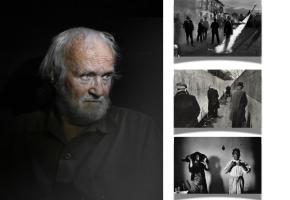





















Reza Deghati, who was born in Iran and is of Azeri origin, has done a lot of work in Turkey and even photographed the earthquakes of 17 August and 12 November!













The photographer, who took photographs in more than a hundred countries and combined his photographs with human stories, was awarded the Légion d'honneur, France's highest civilian decoration, in 2005. Deghati believes that children's smile will fix the world.
Interview: Nihan ÖZGEN & Adem MELEKE
Photos: Reza DEGHATI
When did you decide to become a photographer?
I was 12-13 years old. We were living in Tabriz, Iran. I was looking for ways to express myself somehow. It's always been interesting to me to express two things. The first was beauty. Everything in my childhood was beautiful. I got emotional when I thought about the beauties. I felt the same feelings when I saw poor and homeless people and when I looked at children without shoes. I needed something to explain beauty and social injustice! When I turned 13, I realized that the camera was the best answer to my search, and 56 years ago, I started to learn on my own how to put film into the camera, how to take photos, and what all these numbers and buttons do. Of course, these were difficult years for me, when I learned all this to start photography... I continued this effort patiently. There were no photography departments at that time, so I enrolled in the faculty of architecture at university. This way, I would travel in Iran and take lots of photos. I started my own magazine when I was 18. And finally, in 1979, I was now an architect. The Iranian revolution took place in the same year. I went out and took photos. After this incident, which allowed me to meet the SİPA agency, Gökşin Sipahioğlu asked me to work for SİPA. And I started my professional photography life with SİPA. Afterwards, I worked as an independent photographer for publications such as SİPA Press, News Week, Time Magazine, Life and National Geographic.
You have photographed a wide range of social events and wars. Do you think a photographer just witnesses the events?
True, above all else, photography is testimony, but it is not just testimony. Because the photographer is not a photocopier or a scanner. The photographer is actually a writer, a journalist, perhaps a philosopher or poet... He is someone with his own values and worldview. Even if we say that the photographer is just an eyewitness to an event, the path he chooses, his perspective, the way he sees events, and the way he tells stories still reflect his personality. And this makes him no longer just an eyewitness.
What preparations do you make before pursuing a story?
My first preparation is to put my brain and heart on that path. I have to think about the project, work on it, and search for relevant information on the internet so that I can know who is who, what the event is, and pursue it. Sometimes this information may not be accurate or correct, or different sources may contain different information. But first of all I have to love the story. I have to really want to go, to pull. If you do not know something while you are in the field, you do not have much time to understand whether someone is directing you to the wrong place, especially in conflict or war zones... Generally, in such regions, many people try to distract photojournalists or journalists from their work or direct them to the wrong place. I have to be prepared for this!
We watched your Karabakh file with excitement. You explained all the details of the first and second war. Years later, how did you start photographing the area where the second war took place? What did you plan to go there?
Definitely one of the most important moments in my career was photographing the same place in a similar event 27 years later. Shooting the first and second war of Karabakh was also important to see the surprising differences between the events. Another thing that was important to me was to be able to tell the story of millions of refugees in Azerbaijan. 30 thousand refugees were killed and no one wanted to speak out. They closed their eyes to the war. That's why it was important for me to photograph the second war. Now, one year after the war, I am examining in many books and websites how Armenians held these places for 30 years and how Azerbaijan was able to take back all the houses, villages, palaces, mosques, churches and cemeteries here after 30 years.
We know that you have a very old friendship with Coşkun Aral. Can you tell us a little about the past, where this friendship started, wars and interesting events?
A book could really be written about us. So one day, if a journalist in Turkey were to write a book about Coşkun Aral, he would probably have to mention me a lot. Because he also has a lot to tell about me that even I have forgotten... This is a really important question and a subject that needs to be studied.
We met Coşkun in Beirut in 1982. A few months later, we were in Paris together. So we've known each other for 40 years. We were both in very difficult situations together, and in some of them we even said to each other, "This is probably our last minute!" Our friendship still continues. Coşkun has done incredible work and continues to do so. I think the Turkish media is grateful to his global vision. Because Coşkun Aral became a name that increased Turkey's recognition abroad. It showed that Turkey is not just about Cappadocia, but also has places and people to see in other regions. It may sound like praise to Coşkun, but I want to call him the educator of nations.
Iran is a paradise for the photographer because its nature, history and texture are magnificent. How does it feel to be away from Iran?
If it wasn't an Islamic Republic and mullahs didn't rule it, Iran might be a paradise for photographers, as you say. Outside of that paradise, they created a hell for photographers, journalists and intellectuals. There can still be heaven for people who just want to live. But I say again, this place where religion and state administration are mixed and implemented is still hell! The biggest danger in its history was that pro-religious people wanted to take over the government. I can say this about Iran as a very good historical example that can be shown to all neighboring countries and even the whole world: The Islamic Republic or any religious state administration is a system against humanity and human values.
What qualities should a photographer have?
The most basic characteristics of being human are clearly written in the declaration of human rights. These are also essential features for journalism. Photography is a job to be done with the heart, not the brain. If you are good at communicating with people, empathizing, and have a good heart, you have all the features to be a good photographer.
What do you think about photography and photographers in Türkiye?
In my opinion, the history of photography in Türkiye consists of two main parts. One of these is the period of Ara Güler, the guide of Turkish photography. He not only introduced Istanbul to the world, but also had an incredible impact on Turkish photography by coming together with Coşkun Aral. You can see this influence in the work of later photographers.
Currently, there are good photographers at the international level in Turkey, but it seems like something is not supported for Turkish photographers to achieve more success in the world and to show their work in the global arena. Of course, this problem also exists in other countries in the Middle East and Asia. Photography is not considered a Nobel job around here!
In Turkey, I still do not think that the state, institutions, associations, large organizations or the media understand the importance of contemporary photography. If the government increases its activities to include photography in the media, then Türkiye will become one of the important countries in the field of photography. But I think there is a radar on photography in the country right now.
What kind of projects did you do in Türkiye?
About 30 years ago, I had several important projects for Türkiye. It even appeared as a cover story in National Geographic Magazine... I shot a short film about Istanbul. I attended many festivals and appeared on TV programs. Before Covid, we did a study with Unicef in Turkey where we educated 60 children. Our work was completed in Istanbul, Izmir and Gaziantep. For 4 months, I gave training to these 60 children, some of whom were Syrian refugees, on storytelling with images. We organized a competition after the training. In December 2019, we opened a huge exhibition consisting only of photographs taken by children at Istanbul Airport. I love Türkiye and Istanbul very much! I pass through Istanbul constantly because the new airport is also a major transfer hub.