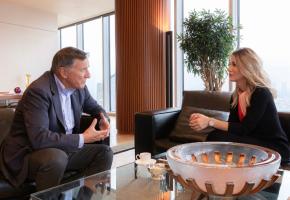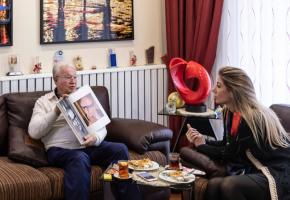





















IFSAK's new president, Dayk Danzig, appointed in 2021, says that an increasingly younger perspective will contribute to the development of the association.













Interview: Nihan ÖZGEN
Interview Photos: Sahra SEÇUK
Photos: Dayk DANZİG & İFSAK Archive
Mr. Dayk, first of all, congratulations on your presidency of IFSAK. Let's go back to the beginning of the story, when did your interest in photography begin?
I lost my father when I was 2 and a half years old and I grew up without a father. It was like this when you emulate someone who is not at home, make them a little more heroic, and give more importance to their belongings. Of course, there are belongings belonging to him at home, two cameras from the 70s... Those two cameras were my connection with my father. It was important to me that they were working. But could I use it or not? Because I didn't know how to use it and it wasn't a movie... I was just making crackling sounds with the mind of a child. The work somehow started with him.
And as I always say, people have their own problems, and if they didn't have problems, they couldn't deal with art. No artist has a clean, very solid mental state. We are all human beings, we have a lot of psychological problems and we feed off of this. Otherwise you can't produce anything. This is also valid for all branches of art. This disability is the beginning of my story with photography... In other words, it is a situation brought about by me growing up without a father and longing for a father. I can say something like this: If those cameras were violins, I would probably evolve into playing the violin. Otherwise, it's not exactly a camera issue. This was an inherited situation from the father.
Was your father a photographer?
No. He was also someone who was interested in photography as a hobby. He was engaged in trade.
So, how did you decide to proceed next?
When the photography branch opened in the second grade, I joined because I wanted to bring the camera inherited from my father back to life. And even though it was a machine from the 70s, the analog era continued in the 80s. This is how I learned the machine and started using it. But I was very bad in the bathroom...
Good thing it came out digitally, you say? (Laughing)
So yeah, it kind of happened that way. Because I'm not a clumsy person in normal life, but I was clumsy in the dark room. I was putting everything back in its place, then something kept falling over. The teacher said, "Oh my son, don't go in, stop!" He kept me away by saying. (Laughs)
We started with the injury in my inner world that I attributed to photography, but at the end of the day, because I was nourished by these and similar wounds - as is the case with every human being - I started to use photography as a means of expressing myself...
You have been taking photographs since your secondary school years, so…
Yes, I received my primary education there. The biggest icon in the community is of course Ara Güler. Inevitably, there is a situation of emulation there. I was born in 1972. I really wanted to study photography after high school, but due to my family's and living conditions at that time, I had to develop in a different field and started working in accounting. But after a while, in the 2000s, I said, "Enough is enough, I want to evolve into this business."
Your passion for photography has emerged again... So, did you receive any training?
You're making money from your job, but that's not what you really want. This is where the system has brought you. My workplace was in Tokatlıyan anyway, and I was very close to here (İFSAK). I came and went several times. I saw that it wasn't working, so I decided to get training. I also received Basic Photography training here. I started taking various other trainings as well. After that, the process felt like a rollercoaster.
When did you become a member of IFSAK?
I was coming and going between 2004 and 2005. I occasionally filled out the form to become a member, but it never worked. It coincided with my busiest days on the financial calendar. Because the method here is, you fill out the form, they invite you to a member introduction meeting. You have to physically come to that meeting. It always happened on my busiest day, but it never happened. The last time I came was in 2013, and that was March - tax month, but I realized it doesn't work, it always falls on the same day, this time I went out and came!
How did the association function in the old times?
The process actually wasn't much different. Basically, the same impression, the same attitude and the same education process continued. Because there is a situation like this, İFSAK is a different place. To be frank, when you enter many other institutions, you feel like a stranger and remain on the sidelines, but that is not the case here. You can suddenly adapt very easily, it has nothing to do with you, your ethnic identity or your beliefs. And these are all elements of something else. Here you just produce, take photos, share together. No one asks why your name is like that... It impressed me a lot at first because it didn't have that kind of mathematics. It continues in the same way since then! Other issues were not the issues we focused on. Our doors are open to everyone who walks through the door and is passionate about photography and cinema, no matter who they are...
İfsak Cinema Unit activity
What kind of duties did you take at IFSAK before your presidency?
If you are not doing this job professionally, this may cause you to suddenly become disconnected. That's why I came, and after becoming a member, I wanted to connect myself to something here. I thought something should happen, let me come here and take part so that I don't get distracted from this job. That's why I worked as an assistant consultant in the training unit, a project coordinator, last term as a vice president, provided consultancy, and gave basic photography and Lightroom training. I always took part in IFSAK in some way.
A Lesson at the Association Center in Şişhane. Instructor: Sabit Kalfagil
What changed in the association when you - I say because you came to the management with the previous president Altan Bal - came to power in 2019? And exactly one year later, the pandemic broke out.
Let's go concrete, let's talk about the facts... Before 2019, before the election, IFSAK had a very serious debt situation. A debt burden of 10 to 15 times his monthly income, which I can say more clearly since I am an accountant, was no longer manageable. This was the biggest problem, and accordingly, the members were unhappiness and disengagement. They had gone too far from here. The number of people coming and going had also decreased significantly. With our arrival, the return of members accelerated; We explained how we would manage the process sincerely and openheartedly. With a transparent management approach and a management style open to criticism... Members came back and gave their support.
You may have very good projects, great projects in mind, but in a place like IFSAK, if the members do not embrace it, you cannot do anything. 18 people say, "We had a great idea," and you return home two years later. They took ownership and we paid off that incredible debt in a short period of fifteen months and now we are in a positive state. And as you said, there was a pandemic on top of this. It has been a difficult process, but I can say this as a life experience. Once you are honest and open-heartedly present the situation, people embrace it, regardless of the circumstances. As long as they believe in your sincerity. That's why we always say the same thing: let's produce together, share together, manage together. Today I am here, tomorrow someone else will be here and this will go as a relay race. The main thing is to keep this place alive, otherwise none of us have any financial gain here. I can say that the process here changed like this after our arrival. Its energy has changed, and many members of the association and the board of directors have repeatedly stated that they felt the obvious change. We celebrated our 60th anniversary, we held very big events, then we had a ball. The truth is, what we saw at the end of the year was a picture that we could not have dreamed of 8 months ago. I also expressed it within ourselves during the election period in January, "Be aware of the number we have reached, the debt we have reached, and then do not be demoralized when something does not happen suddenly." But in December 2019, we reached an incredible point!
So, what did you do as an association during this pandemic that we encountered for the first time?
As I said, IFSAK has a family structure. It was the night of March 16, the night when the pandemic was first announced. There was a board meeting here, what were we going to do... Believe me, a week and ten days later, I was giving training to all units on an application called Zoom, which I had never used in my life and was not even aware of. We continued our events and seminars from there. Within ten days, the seminar and workshops unit, the event unit, we all adapted and suddenly started holding events via Zoom. Because IFSAK is an association that has experienced that it will not conflict with technology. Some people are closed to developments, they wait and watch. We do not have such a situation, we adapt directly and thanks to this, we continued our seminars during the pandemic and tried to increase diversity. At first, of course, this is a new situation for people, there was a lot of participation, but then there was a slight decrease. Because it is not suitable for our body, ultimately it does not work. I also gave lectures there, but I felt like I was teaching in my own room, against the wall. I'm a guy who does stand-up classes here. I make jokes on the screen, I don't see if they laugh or not. It was a different situation, but we got through it.
Is what is being done in the field of photography in Turkey sufficient?
We are basically fooling ourselves. Why? This is not only about photography in this country, but also about all arts and sports fields. We do not think of finding a talented person, bringing him to a point - and he will reach a point with his own work - and putting someone next to him for those long periods of time. We have infrastructure problems, we have intellectual problems, we have cultural problems. You can get a camera, you can get a camera to shoot movies, and you can also get training on them. But finally learning something doesn't mean it's over. At some point we have to continue to improve. There are also academics. He enters the school as a university student, studies, graduates, becomes an assistant, gets a doctorate, submits his thesis, and continues as an academician at the university. But he doesn't get out of this bowl, he doesn't open up to the world, he doesn't go anywhere else, that's why he can't improve himself, he can't take his situation outside.
Now, we, as a community, have found something here. At the time, community centers were closed, and İFSAK took it as a mission to spread the photography and cinema section to the grassroots. Today, nearly 99 percent of Turkey's most important names in photography and cinema come from here. However, everyone wants to receive photography training because they see this. Okay, let's give photography training, but to what extent? How far will we go by teaching this machine? For example, to what extent do we follow the demands of young people and the current state of the world in photography? And how much do we really give meaning to things other than suffering? For example, when you look at the word 'photography' today, it means completely different things.
For me, it doesn't matter what he took the photo with, what matters is what he wants to say. We are very weak in creativity, we just focus on using the machine. After you learn this, the issue is over. He keeps saying, "I have come to a point, I opened an exhibition and I have come to another point." We are not trying to go one step further, we are not developing institutions. We cannot automatically be in the same integration with the world. We cannot make progress unless we can produce creative and effective work. For this, we need intellectual development. You asked at the beginning why you started photography, there is a problem inside me, there is a problem inside people. Photography is a tool to convey and explain this. Of course, it can also be used for other areas, I respect it. But if we look at it from the perspective of photography, I will explain my problem with this. Correct expression methods do not depend on taking technically perfect photos. This is our main concern! I shot clearly, I shot straight, composition rules, shooting techniques... There is no such thing...
What should happen?
It has to contain meaning, it has to be able to convey a message. It needs to be an effective, creative photo.
For example, if we take a landscape photograph, it does not actually give a vital message as you mentioned...
Landscape photography, of course, has a situation where it is effective in its own field and is used specifically. I can't say that it doesn't mean anything at all, but when you look at it now, a photograph can sometimes open an era and close another. He can start a war and end a war. This is something that has a very effective saying. There is no need to reduce it so much, trivialize it, and limit it to just a composition rule, a shooting technique, or criticisms like it's not clear or lacks clarity. Why should I limit the creative thinking of a person younger than me by my own capabilities? That's what we do most. We produce clones. Maybe my thoughts are not enough, he looks brighter and differently than me. We do this to our children as well, we say, "Shut up, don't talk, don't interfere with the adults." Let them interfere. We are not getting anywhere with this suppression. That's why, unfortunately, we are stuck in the 1950s. We need to focus on more creative work and try to pave the way for people who do this. We need to increase the number of young people. Everyone complains, they say, "Young people do not show interest." This means that we cannot come up with an educational method or approach that will attract their attention. Although there are many female photographers in the community, they do not want to be active. We have repressed women so much that they become anxious when it comes to expressing themselves. All of these are our interconnected intellectual troubles.
Okay, we teach photography, but we need to complete the intellectual development of art along with photography. Otherwise, we just look... For example, people go to the museum, look at the painting, but they don't know what is in that painting! That's why it's just a photo of a woman, a man, a candle. You look at Leonardo's paintings and frescoes and say, they are important to me because they are important to art history. However, you don't make an analysis yourself, you can't. Because that intellectual background is not there. I ask him to tell me about the sadness, he says, "How can I explain it, teacher?" However, we are all wounded, we all have a problem inside us. The simplest thing is that your classmate next to you in primary school tells you something and creates a complex in you. For example, reflect this in your photo. You'll get a great result. Which artist is healthy? How many world-renowned photographers do we have in a population of 90 million?
Let's say there is one that immediately comes to mind…
We'll squeeze one or two next to them. But this is not true. They are leaving Brazil, they are starving to death. Why doesn't it appear in ours? Because they are telling their problems. Photography has been allowed in our country for 20 years. It was a sin if you wanted to shoot in the village... How can we move forward in such a situation? We can't go…
I think this is actually a deficiency in our view of art rather than photography...
Of course! We need to train this. You will start training from primary school 1. For example, we cannot overcome the Renaissance by only knowing its literal meaning. We need to know the basics of art movements. Otherwise, you cannot practice photography as art. You can't do anything new without knowing what your predecessor did. You can't write a book without reading a book. You will read so you will write. You will work hard. For example, you are the only magazine in the whole of Turkey. There is no person who does not take photographs, there is no person who is not interested in photography, and the value of that magazine is unknown. The world has become smaller, traveling is very trendy and photography is just as much... Everyone shares photos if they get on the ferry from here. There is no equivalent of a magazine that brings these two concepts together... This means that we are not interested in real problems, which means it is time to abandon some photography projects... I think we need to do things that will develop and encourage people with a little more intellectual and cultural background.
What kind of contributions does IFSAK make to the development of photography in Turkey?
When photography started academically, all the people involved in it took their basic photography seminars at IFSAK, which may sound funny to people today. These are the people who took the seminar here and became the head of the country's academic photography department, managed it and brought it to this day. And so on. IFSAK, founded by Nurettin Erkılıç and developed by Şinasi Barutçu with his experience and intellectual personality, has made a significant contribution to our country's photography from past to present. The situation here will continue, but our entire goal is to expand abroad. We need to ensure the transfer of people from there to here, and people from here to there, so that we can accelerate development. People can improve by communicating. We continue to work in this direction. This is the mission of IFSAK. It has been going on since the day it was founded. Despite everything, we will continue…
Well, are there any associations you work with or have agreements with abroad?
Yes, there are a few associations we met with, especially in the Balkans. Of course, it's a bit about communication. We also have members in the board of directors and IFSAK members who have communication on these issues. Thanks to them, we are in contact with these associations. We have very serious plans in the coming period, to make this work more concrete and effective...
Where do you rate our country in world photography?
I cannot say that we are going very evenly as it is. They are completely different, they are far beyond us. When you look at examples around the world, photography has reached a completely different point. We are still interested in what and how it was shot. We are debating digital or mirrorless. We ask if it can be filmed by phone. But even with canned food there is no problem, it is the result that interests people. When we look at the world, we are a little behind in this integration. But this does not mean that we will always stay like this. If we can determine this and do it together, this will work. If we participate in photo contests, earn a good income from there and say "let's save it today", this is not enough. We will do these, but we need to do things that are more important and where we can produce effective work. There are already places abroad that do these, we will stay in touch with them, work together and develop.
What do you think are essential for a photographer?
He must have a problem. He must have a lot of trouble. If you don't have a problem, nothing will happen. You must have a problem of conscience. There must be a trouble whirring inside. If there is nothing in your conscience and you don't care about the world, you can learn how to use this machine very well, even buy the best machine, but nothing will come of it. As I just said, make a hole in the can, give it to someone who has a problem, what comes out of it!
Were you exposed to violence when you were little, you will vomit it up. We have a disease of keeping ourselves to ourselves. We are becoming an unhealthy society. We all have wounds and resentments. We will feed from here. The recent problems we have experienced are obvious. Make a project about ecological problems. But don't do it just because it's trending. Do you really care about him? If you care, do it. Do something for him, show your reaction, but let it belong to you, don't use it as show material. There is no photographer, painter or musician without worries! You can't write poetry without being in love. In fact, you write better when you're abandoned, let alone when you're in love. It is something like that. There will be turmoil in your soul, storms will break out, otherwise you will not be able to produce anything.
Can we get information about the association's future projects?
In the past, exhibition projects were carried out that were ordinary and we saw many repetitions. Nowadays, more intellectual and creative projects are being carried out that require people to think seriously and add something of their own. Our relations with institutions are also improving, we have a very important project that we will announce soon. Addressing our social problems is our first priority. We focus on women and youth. I think, as a country, we have raised awareness about women at a certain level, especially in the last five years. But of course this is very minimal. The point of view in our country is obvious, but at least there is a little more awareness. Of course, in this context, it is important for female photographers to have access to spaces where they can express themselves. We will continue to work for this.
We have also lost touch with young people. They don't necessarily prefer it. This structure, this order does not serve them. They do not see it as an area where they can express themselves. The main thing here is that I don't think we are the ones who will produce the solution. Because my mind is already enough for this, and because it is enough for this, they do not come. So, young people need to come and manage us. That's why we will give the floor to young people. In the coming period, we will give all the management and the say to the young people. They will guide us. When they come here, they will tell us what they see as missing, and we will complete it. And the heart desires that we see the days when the number of women and young people increases and they are in management. Because, to be frank, I have trouble with that issue too, I grew up in that generation too. No matter how much I try to improve ourselves, I can never fully understand a woman or a young person. Gradually, our adaptation with Europe will be like this. We need to know how to leave the field to its owners, to the people it should be. Young women and men who think about things we cannot think of will come and then we will take ourselves to a better point.
A very nice thought... So, what final message would you like to give?
All the trainees who come here want to be the ones who look through the viewfinder of this camera and press the shutter. However, there is no situation in the photo that ends only with the person who took it. It has an editor, it has a curator... But everyone wants to be the one pushing the button behind it. And at some point there's no one dealing with the rules part of it. After all, photography is a tool. It's a tool you use to express yourself. If I had the ability to draw, I would be a painter. Since I cannot draw, I take photographs. Another person writes poetry because he doesn't like taking photographs. This is such a situation. You express yourself with whatever you can. You don't have to know how to take photos when it comes to writing it down, either. You may not take very good photos, but you can choose which photo best describes the subject among the photos you see. Or you may have an impression of which photographer will bring more accurate work to that exhibition. You can be a curator, you choose photographs. You go and make an agreement with the museum, and when exhibitions will be held there, you can be the person who determines which photographers you will work with and which ones are suitable for the job. And you can also write, you can sign. But we have such a complex, such a "I did it, I know it" situation that... "Those who don't know how to take photographs cannot write this, those who don't know this cannot take this." There is no such thing. If you read, are interested, and improve yourself in this field, you can write and criticize. To become a cinema critic, it is not necessary to go and make a film, direct it, or receive an award at the festival.
Do you mean that watching a lot and being knowledgeable is enough?
Of course. There is training for this, you get that training. You can improve yourself and write a review about the movie you watched. No one can come and say you are criticizing me. Finally, let me be clear, you can write your name below for anything written by you or your interpretation. At the end of the day, it's your comment... Someone else's different opinion should not prevent me from expressing my own feelings and thoughts! With this awareness, I suggest we stand firmly on our feet.