



















If your office is at an altitude of 340 meters, there are two possibilities: Either you work in an office where you have a nice job on the last floors of a skyscraper, or you work to photograph adrenaline-filled sports like me. I invite you to my office in Şahinkaya Canyon, one of the most beautiful canyons of our country.













Text and Photos: Mahmut CİNCİ (Nikon Brand Ambassador)
This canyon in the Vezirköprü district of Samsun, which I first visited in 2016, fascinates those who see it with its nature and majesty. It is a unique piece of nature for photographers, with its combination of both green and rocky texture, its base width falling below 100 meters in places, and the Kızılırmak River flowing through it. Especially if there is a festival where extreme sports are held in this canyon, then we can call Şahinkaya Canyon as heaven on earth for me.
After landing at Samsun Çarşamba Airport, we reach our camping area with a 2-2.5 hour road journey. By the way, you can eat wonderful menemen in the area called Çakallı on the road. After setting up our tents, we rest at the campsite. We arrive at the canyon early the next morning with a short journey. Tour boats first welcome us in the canyon. You are fascinated when you see the entrance of the canyon with all its majesty. It is a region where you feel the Black Sea nature very much. All shades of green are available.
We cross with tour boats. After this pleasant and short boat ride, approximately an hour of trekking awaits us. It is important that we do this walk before sunrise because we do not want to stay in the heat. We have a mostly uphill road to climb above the canyon, where rock walls are 350 meters high in places above the water level. However, this walk, where you gain height with each meter and the view constantly changes, will increase your pleasure quotient. If you are lucky, you may also witness the natural phenomenon called the sea of clouds. Imagine a pure white sheet created by the fog layer below your altitude. After an hour, I arrive at my office and look down at the canyon. It really looks amazing! For a few days in this office, I will be taking photos of Wingsuit BASE Jump, BASE Jump, Rope Jump, Highline and rock climbing, which are among the most adrenaline-filled sports in the world.
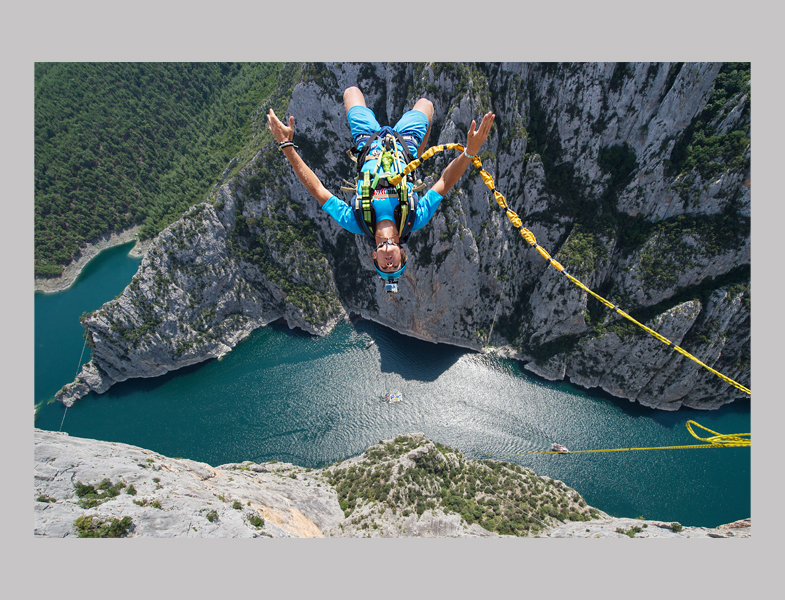
Our first shoot is Wingsuit BASE Jump and BASE Jump. First, I create my security with the safety equipment I bring with me. I put on my seat belt and secure myself on a solid rock. In other words, I secure myself by tying the ropes that I securely tied to that rock to my seat belt. The reason I did this is that the point I wanted to reach for shooting was on the edge of a 330-meter cliff. Establishing my life safety correctly is important to prevent anything from happening to me and to ensure that I can concentrate on the photos I will take without feeling anxious while working. Because I photograph instantaneous movements and I don't want to lose attention even for a second. After completing the security procedures, I cautiously take my place on the edge of the cliff. The athletes will throw themselves into the void on a rock ledge approximately 10 meters above me and 30 meters further. After the fall begins, they will stay in my frame for a moment and then open their parachutes and land on the platform on the river. Safety boats will be waiting in the water in case anyone cannot get down to the platform. I have a second or two to take a photo in the frame I want, and I should use it well. Since there is no communication between me and the athletes, I have to be alert at all times. Correct AF, shutter speed, aperture and ISO settings are important. I have two cameras with me for this shoot. I will shoot with the Nikkor AF-S Nikkor 70-200mm f/2.8G ED VR II and Nikkor AF-S NIKKOR 14–24mm f/2.8G ED mounted on Nikon D3s and Nikon D4s bodies.
I plan to photograph the athlete with a wide angle to capture the magnificent view of the canyon, and towards the end of the fall, with a telephoto lens. And then the jumps come. On average, an athlete jumps every 3-4 minutes. With the happiness of getting the photos I wanted, I safely leave my office on the cliff to reach the 'rope jump' ramp, which is 50-60 meters ahead and 10 meters higher.
For rope jumping, there is a rope of approximately 500 meters stretched between two rocks. When the athletes let themselves down from the ramp, they are connected to the main line with another rope attached to their belts. Since the rope lengths are pre-set, when you reach a certain height, the main line slows you down and you slowly descend without swinging back. Before I start shooting, I take the same security precautions. Unlike where I was just now, I'm here with the athletes. My goal is to take wide-angle photos from right next to them as they jump. I am in a relatively more comfortable working environment compared to my previous shooting location, but being on a ramp does not increase the level of excitement! Since there are fewer athletes at this point, my work takes less time. After enjoying the view for a short while, I slowly recover. I will retrace the path I walked early in the morning. After a short lunch break, I'll take photos of rock climbers and highline athletes.
Rock climbing and highline are relatively easier shoots, but I still have to step out of my comfort zone to find the best angle for myself in the difficult geography. First, I get on the boat to go to the rock climbers and reach the entrance of the canyon. After spending a few hours here with the climbers, I will have to walk/climb through the rocks to get to a height of about 70 meters to take photos of the highline athletes. This part was a bit challenging with my equipment bag on my back. Because I had to get help to cross some rocks and for that I had to wear a safety belt. At the end of the day, I was happy. I returned to my tent with the photos I wanted.