



















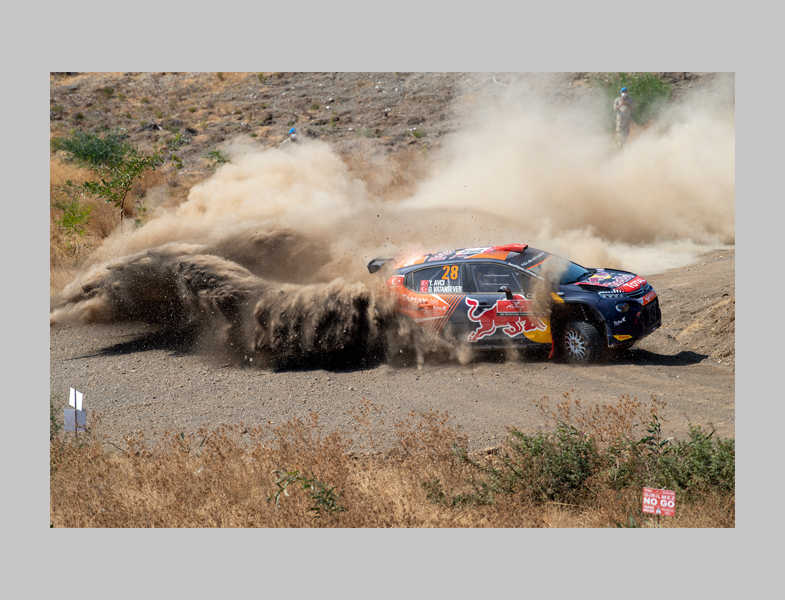
Cars reaching speeds of 200 km per hour, meter-high dust clouds they leave behind, the exciting engine sounds of the vehicles... Today, I will take you into the dust and soil. You will feel the taste of the dust while reading the article.













Text and Photos: Mahmut CİNCİ
The World Rally Championship (WRC), in which I took part and which was held consecutively in our country in 2018, 2019 and 2020, is considered the highest level event of motor sports, along with Formula 1. As these fast cars literally scrape the ground with their power approaching 400 horsepower, they leave behind a very high cloud of dust, which remains in the air for a few minutes. Of course, this means that it is a very difficult office for photographers and videographers to work in. When you are exposed to this dust every time a vehicle passes, after a while you know what the dust tastes like. Let's spend a week in the WRC now.
Preparation
I arrive in Marmaris four days before the race. After checking into my hotel, we meet with my Estonian colleague Jaanus Ree, who is also a Red Bull Photographer, have dinner and make our Location Check plan. On Monday morning, at 07:00, we depart from in front of the hotel and reach the first track. We have the rally booklet given to us and this booklet contains all the information we may need. We prefer to go on the course based on the start times in the booklet. The angle of the light changes every minute, and we want to capture the most beautiful light and position by taking notes of what time, where and what kind of light comes from. When we start moving forward on the track, we try to identify points where we can take good photos. When we decide to take a photo at a point on race day, we mark that location on the map so we can easily find it on race day. We go through all the tracks of the race one by one and do this. After spending Monday, Tuesday and Wednesday in this way, we start shooting the race with the first stage on Thursday morning, and now each photographer is on his own path. But we are in contact every day. We hold short meetings for both general information sharing and new planning in case of any developments.
First Day of the Race
We wake up quite early on race days. Although it varies depending on the track I'm going to, sometimes I wake up at 04:30, sometimes at 05:30. The hotel's breakfast service usually does not start at those hours. I take with me a few fruits that I prepared the night before. I get on my motorcycle and move towards the track. When I arrive, there are still about two hours until the first vehicle passes. Meanwhile, I'm doing my installations. I prepare my remote camera, place it in a suitable place and take my test frames. If there is a chance, I will have my breakfast by eating my fruits.
We understand that after the lead control and security vehicles pass, there is only a short time left for the first vehicle to arrive. And with the sound of that powerful engine, the first vehicle is approaching us. The point where I am is a hill and the vehicles pass from here by flying for meters. I take photos from the front with my telephoto lens on one camera, and from right next to the track with my wide angle lens on the other camera, using a remote control. After each vehicle passes, I go to my remote camera with my air jet, remove the dust in front of the lens for a clearer image, and start waiting for the next vehicle. After finishing this stage, I will go to the afternoon stage, but I have one more job to do in the meantime.
I stop by the paddock area and take photos of the athletes in the paddock. I have to get to the next track without wasting too much time. After squeezing in a quick meal and lunch, I quickly move on to the next track. After leaving my motorcycle, I begin my walk to the point I determined before. I reach my goal with about a 15-minute walk. Just like in the morning, I prepare my cameras and wait for the first vehicle. If there is time for the vehicles to arrive, I turn on my computer and transfer the photos of the previous track, and if I still have time, I start editing while I am still on the track... In the second stage, after passing the vehicles, I collect my equipment, reach my bike and return to my hotel. This usually happens around dinner time. So, I leave the hotel before sunrise in the morning and return at sunset. While I quickly make my transfers, I prepare myself and my equipment for the next day. First, I charge the batteries of the equipment. After a shower and dinner, I'm back in front of the computer and editing the photos of that day. As the clock approaches midnight, my body tells me I need to sleep. I go to bed for 4, maybe 5 hours of sleep.
The next 3 days proceed like this. On the last day, I additionally photograph the award ceremony. During this time, I also experienced interesting things such as being attacked by bees while walking on the track and being stung on the head by two bees, and the colors of my equipment turning orange from dust. While it's definitely one of the toughest events I've ever worked in, the WRC is high on my list of favorite events to be a part of.
Equipment
During a rally shoot, I have some additional needs other than photography equipment. The most important of these is a dust mask or double layer buff. It is not easy to breathe in a dusty environment and I need to breathe by filtering the dust to protect my health. Work gloves are also among the items I keep in my bag. Because sometimes I may need to wear gloves to prevent my hands from getting hurt while climbing rocks. Work glasses or good sunglasses are extremely important in protecting your eyes from particles bouncing off vehicles and dust in the air. My choice is sunglasses at this point. Good trekking shoes are very useful in the forest and on rocky ground and help me stand firmly on the ground. I can fix my cameras wherever I want with my mini tripod and clamp pod.
What about cameras and lenses? As is the case after every WRC shoot, they head straight to the Nikon Türkiye Authorized Service. After a good dust care, they take their place in the bag for the next shoot.