




















Sony held an online event where it introduced eight technologies that guide the company's development under the title "Technologies that inspire emotions".













Sony Group Corporation Executive Vice President and CTO Toru Katsumoto , said in his speech at the opening of the event: "I hope to lead the way in bringing together the disparate branches of Sony Group through talent and technology. This unity will significantly contribute to developing our products, content and services in a way that fills the world with emotions."
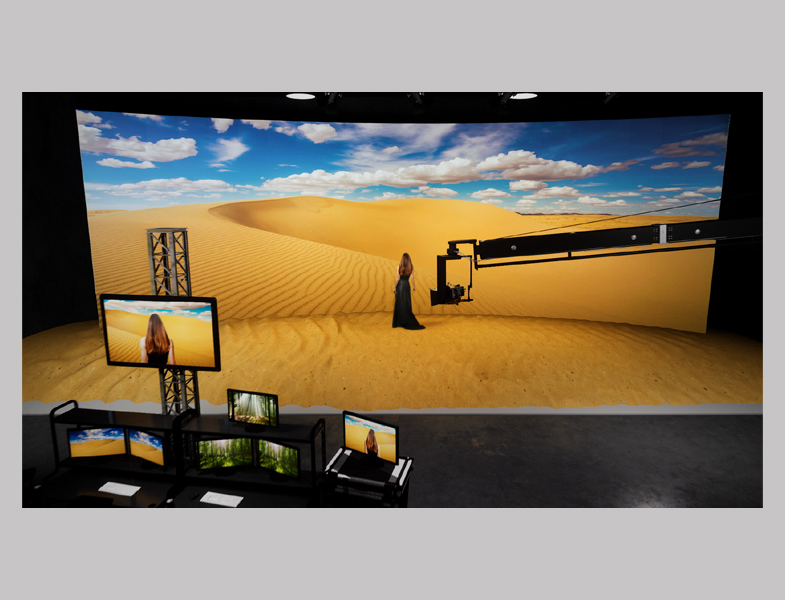
Virtual Production Becomes Possible Thanks to Crystal LED and Cinema Cameras
Thanks to “In-Camera VFX”, one of the types of Virtual Production, a 3DCG image associated with the movement of the camera is projected as a background on an LED screen placed behind the actor in the studio. In this way, content creators are relieved of both the burden of creating the CG composition required for traditional green background shooting and the constraints such as weather, time and space.
Crystal LED is an LED display that combines Sony's unique LED control technology with signal processing technology developed at BRAVIA®; It provides high-definition images with extraordinary realism with high brightness and wide viewing angle. Equipped with a newly developed 8.6K image sensor, the digital cinema camera “VENICE 2” offers a wide color gamut for rich expressions and is capable of expressing the richness of grayscale even in a wide range of brightness conditions.
The combination of Sony's signature screen and cameras has high color reproduction and color tone expression, making it possible to produce more realistic content. Not only that, Sony Group is also preparing to deepen its collaboration with content producers and engineers working with the film world, both within and outside the Sony Group, to encourage the development of Virtual Production solutions that can produce high-quality content.
Visualizing All Performances with EPTS and Data Visualization Technology
Hawk-Eye Innovations Ltd, one of Sony Group companies, also draws attention to Electronic Performance Tracking Systems (EPTS), which collect real-time movement data with millimetric accuracy by capturing the movements of the players and the ball in the match from live video images captured by special tracking cameras in football. Hawk-Eye's data visualization technology, Virtual Recreation, was also used to create virtual images by processing data from EPTS and video review systems.
Advanced image processing and AI (Artificial Intelligence) recognition technologies perfected by Hawk-Eye come together with Sony's specialized broadcasting capabilities and image sensor technology, and transform the entire match into data, including all the details, down to the players' postures, making it possible to visualize performances that were previously impossible to capture.
Sony Group and Hawk-Eye aim to apply this technology to various branches of the entertainment industry in the future, not being limited to sports, and thus contribute to the industry.
Sharing Experience with an Extraordinary Sense of Reality
Sony offers a 'head-mounted' virtual reality (VR) display (HMD) that displays a high-resolution 3D space and achieves high resolution of 4K with one eye and 8K with both eyes. High image quality; It is achieved thanks to the Organic Light Emitting Diode (OLED) micro display, which uses device and circuit technology, which emerged with the development of displays thanks to the multi-pixel and miniaturization achieved using both the precision processing and advanced packaging technology that emerged as a result of the development and production of CMOS image sensors.
By integrating data from different sensors, processing time is reduced by reducing latency across the entire system. With VR, the viewer can experience high-resolution images in real time based on head movements. It is anticipated that OLED micro displays, which can display the texture of materials and human expressions in high resolution, in real time, according to the viewer's head movements, will be used in the entertainment field as well as in industrial applications.
Stay in Balance Between Super-Resolution Technology and Production Efficiency
Leveraging the know-how gained in the process of improving images using machine learning since the 1990s, this technology maximizes performance with limited computing resources and enables high resolution with high precision from different perspectives for images of various quality. For 3D content with large amounts of data, it is possible to reduce production time by several hundred times by reducing the number of rays used and processing images based on information such as character shape, texture and lighting. This technology is being developed in collaboration with Sony Pictures Entertainment, reflecting the voice of content creators, with the aim of expanding application areas from 2D to 3D and offering a wide range of applications in the field of entertainment.
Three Breathtaking Technologies Used in PlayStation®5
Three technologies used in PlayStation®5 were introduced: Tempest 3D audio, haptic feedback and adaptive triggers. Tempest 3D audio is designed with DSP (Digital Single Processor) to deliver extremely precise sound positioning; Thus, the sound can be heard from all directions at 360 degrees around the listener, as if they were inside a sphere with countless speakers. Haptic feedback changes the vibration of the newly developed dual actuators according to the in-game situation, creating a range of different haptic responses, thus providing an immersive experience. In addition, the DualSense™ wireless controller features adaptive triggers placed on the L2/R2 buttons, a small precision gear and a high-torque internal motor, providing powerful real-time tactile sensations in response to in-game actions.
SPAD Depth Sensor Providing High Sensitivity Detection from Light Particles
Sensors that detect the distance to surrounding objects with high precision by capturing low light energy levels essentially consist of three elements: SPAD (Single Photon Avalanche Diode) pixels that capture light and convert it into electrical signals, Cu-Cu connections that transmit these signals, and logic chips containing circuits that extract distance measurements from the signal. Benefiting from data obtained during the development of Sony's CMOS image sensors, these sensors measure both short and long distances with high speed and high precision with a single compact chip.
Sony Group aims to support a safe and secure mobility society by contributing to the development of LiDAR, which is used for detection and recognition in the automatic sector.
Rediscover the Sensitivity of the Human Hand with the “Manipulator”
It is a technology that allows robots to carefully grasp unknown objects by detecting in real time signs of the object shifting based on changes in the pressure distribution detected by the fingertips. With this technology, robotic hands can grasp an object without dropping it by adjusting the force used as necessary. In addition, since the distance sensor detects the distance between the fingers and the object, the robot can hold the object with the correct position and posture.
Since the manipulator can grasp objects precisely, just like the human hand, this technology is expected to assist humans in new areas where traditional industrial robots cannot be used. By combining artificial intelligence and advanced sensing technology with robots, Sony aims to increase the capabilities of the manipulator and continue to develop robotic technologies that will enrich people's lives.
World ‘MIMAMORI’ Platform Protects the Planet
It is a system that, if implemented, will help prevent problems before they occur by detecting signs of abnormalities such as environmental problems and disasters, detecting what is happening at any point on the earth. This system will encourage humanity to act with sustainability in mind by warning in advance of potential anomalies.
The system includes soil moisture sensors that can measure moisture content; ELTRESTM, a satellite communication system using LPWA (Low Power Wide Area) wireless communication technology; and Sony Group technologies such as advanced predictive data analytics technology using artificial intelligence. With field studies and demonstration experiments, Sony continues to work to implement this platform in order to contribute to a more sustainable future.