



















FROM THE PEN OF ERCAN ARSLAN…
AFTER ARA GÜLER…
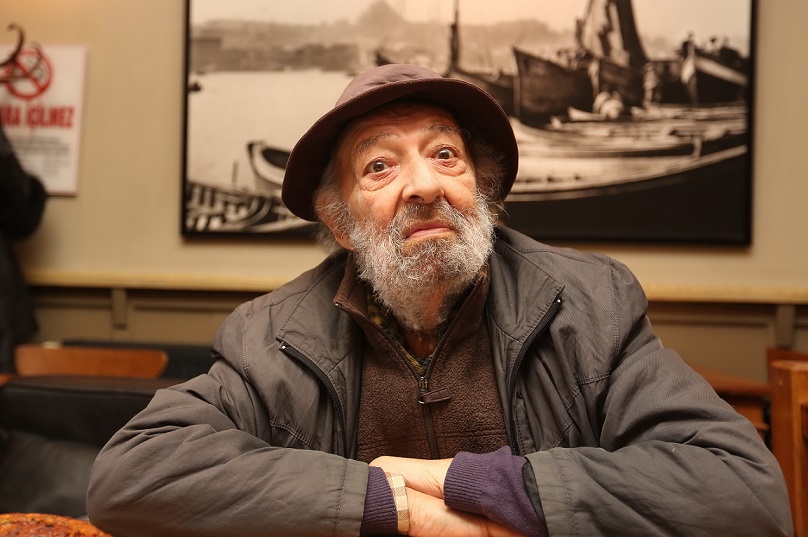
is a photography legend who has devoted most of his 90-year life to photography. Countless interviews have been conducted, theses and books have been written about him, documentaries have been shot. It would be unfair to him to describe him in a few lines...













Text: Ercan Arslan (Photojournalist)
I think I am one of the lucky people around Ara Güler, a world-class doyen of photography and a wise person, in the last 22 years of his long and lonely journey in photography, as a photojournalist trying to document his own period like him.
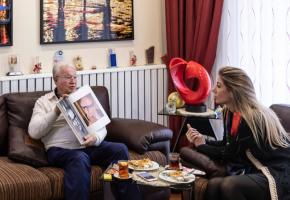
I first went to his office in 1996 to buy a book about his friend Josef Koudelka. We have a photo we took that day: He is sitting at his desk in his office in Beyoğlu, where he is legendary, with a cigarette in his hand, sitting at his desk with a radio phone saying "This is the office of Photojournalist Ara Güler", and me, as a rookie photojournalist, standing proudly behind him, exactly where I want to be... He is 68 years old, I am 26 years old.
This acquaintance initially started as a professional solidarity between two photojournalists on the basis of a master-apprentice relationship who passionately loved their job. Over time, it evolved into a companionship sharing Istanbul, conversation and the table through photography. Joint exhibitions, television, newspaper interviews and companionship crowned with assistantships were professional experiences for me to be proud of.
Our last meeting was the day before his death, I went to visit him in the hospital where he was hospitalized, he was with his friends. When I entered his room, he was on his bed, pillows upright, his eyes closed, breathing deeply. Perhaps the evening sun was hitting the face of the man chasing the light for the last time. His assistant Fatih Aslan said: "Call, brother, look, Ercan is here." He opened his eyes and a word came out of his tired lips. Then he closed his eyes again. When you say goodbye to someone you love, you stare at them until they disappear. I looked at the Master for a long time. Then the doctor entered the room and wanted to talk to him, but the Master was not in a good condition and did not react.
It was as if the 90-year-old great plane tree of Turkish photography had filled all the frames of the empty film strip given to him and was preparing to say goodbye for his last journey. This hospital room was the last unphotographed moment we saw eye to eye with him, 22 years later. One day later, he said goodbye to us with a perfect death. The world of photography has lost one of its brightest stars, someone close to us.
Ara Güler used to spend his remaining time due to his recent health problems at the picnic table in the middle of Ara Cafe. It was the place where he connected to life and hosted his friends. There was always someone with him. Whenever I passed by, I would stop by and ask how he was doing, and we would mostly talk about his memories, photography and homeland issues.
He had a very high ego regarding photography. It wouldn't be a lie if I said that he didn't like many photographers other than himself. He would say, “I suffered through everything, people today are suffering.”
James A. Fox, Chief Editor of Magnum Agency, said about Ara Güler: "Above all, he is a generous, elegant and humorous person. He is one of the best storytellers I know. His life, like many famous photojournalists, is full of anecdotes. These are the living memories of our century that were never reflected on film, only partially captured by cameras." he said.
Ara Güler has talked on various occasions in different media about how he worked hard and the price he paid to always be in the right place and at the right time. His book of interviews with journalist Nezih Tavlaş, "Photojournalist", may be a good choice to understand him.
Ara Güler's Photographic Journey
Ara Güler starts his photography by making "art" in his own humorous language, with the sunset photographs he took in Büyükada. He shows that he takes his job seriously by building his own darkroom on the upper floor of his father's pharmacy. After a while, when he sees himself constantly repeating himself in sunset photographs, he begins a new search.
In 2013, we stopped by the shop with its first darkroom for an interview. The person sitting at the counter said, "Brother Ara, there were a lot of your photos upstairs, we threw them all away." My eyes felt like they were going to pop out. He didn't care at all.
Photojournalism
Ara Güler started working as a photojournalist in Yeni İstanbul Newspaper in 1950. He starts by taking photographs of sports and crime events. In sports photojournalism, he learns how to capture the action behind the goal, how to be fast, how to compete with time and journalism in addition to capturing the moment in detective events. No one has come across a sports photo in his archive yet. Probably, in the archive scan, we will only be able to see sports photos in newspaper clippings.
First Photo Interview
Ara Güler was a photographer who knew the language of the street and communicated easily, and he reflected this in his photographs. He made his first interview with Kumkapı fishermen. Some of the photographs he took that day are among his most beautiful Istanbul photographs. He said he loved fisherman's conversations.
I used to think that there was a love between Istanbul and Ara Güler. Istanbul presents all its beauties to his lens, and he immortalizes these moments. Istanbul has the lion's share in making Ara Güler a legend. He had special places in Istanbul where he constantly went, found himself and refreshed his memories. Sometimes he would say, "Let's go to the lighthouse, Suleymaniye, Emirgan," and when I said I had work to do, master, he would scold me.
Ara Güler said that he was very impressed by Sabahattin Eyüboğlu and that he learned a lot.
In order to improve himself professionally, he closely follows Camera and Leica Photography, the biggest magazines of the time.
He is aware that the camera is a tool, but his dream is to own a Leica, as Henri Cartier Bresson and Robert Capa, who are talented at the level of genius he calls "our master" and who later became his friends, used Leica.
He said that photographs were taken in the mind before the camera. The well-known saying "If the best typewriters wrote the best novels, the best cameras would take the best photographs" emphasizes that photographers should not get stuck with their cameras.
In 1954, Ara Güler started working as the photography department chief at Hayat Magazine. In 1958, he took on the duties of Near East photojournalist for Time-Life, Paris-Match and Der Stern magazines.
Meanwhile, he establishes friendships with the world's most respected photojournalists. In fact, Ara Güler accompanies them when they come to Istanbul. Henri Cartier Bresson, Robert Capa, Sebastio Salgado… There are also those I witnessed: Josef Koudelka, Marc Riboud, Filip Jones Griffiths, Bruno Barbey, Steve McCurry, Nikos Economopoulos, Reza, Raghu Rai…
Ara Güler used to say, "I want to shoot permanent celebrities, not temporary celebrities." Many famous people from around the world and Turkey posed for his camera. He was, in his own words, an "insatiable" photographer who pushed the limits to capture the soul of the people he shot. He said, "If it weren't for me, Turkish Literature would remain shameless."
“I think I made three important interviews throughout my journalism,” he would say, “Mount Nemrut, Noah's Ark and Aphrodisias.” I think his best interview is his longest-running work, "Istanbul".
The British Journal of Photography Yearbook selected Ara Güler from Turkey as one of the 7 star photojournalists of 1960. In 1962, he earned the title " Master of Leica ", which was given to very few photographers in Germany. Ara Güler lived with the sound of the shutter in his 90 years of life, left behind two million photographs, a cultural heritage that made the biggest contribution to the visual memory of this country!
Ara Güler and the Museum
He knows Ara Güler's house and office, he hasn't even thrown away those empty film canisters, even his personal belongings are still there, as if a museum was going to be established. He used to say that a museum was essential for a photographer to survive.
Master photojournalist Ara Güler and Doğuş Group demolished Ara Güler's Güler Apartment, located at number 4 on Ara Güler Street in Beyoğlu, where he had his gallery and office, and founded Ara Güler Doğuş Sanat ve Muzecilik A.Ş. in 2016 to establish Turkey's first photographer museum in its place. founded his company. For two years, countless photographs and documents belonging to Ara Güler were numbered, moved to Bomantiada, owned by Doğuş Group, classified and transferred to the digital environment. Until the museum in Galatasaray was built, Ara Güler's photography world would be in the temporary museum venue Bomantiada. The museum opened its doors for photography lovers with the "Whistling Man" exhibition on August 16, 2018.
The day the museum opened, we were together until the evening. He was happy about the opening of the temporary museum, but he said that the building in Beyoğlu should be completed as soon as possible. He used to say that when people look at the photo on those walls, they will talk and I will hear what happened.
If you want to talk to the master through his photographs, do so! He will hear you.