




















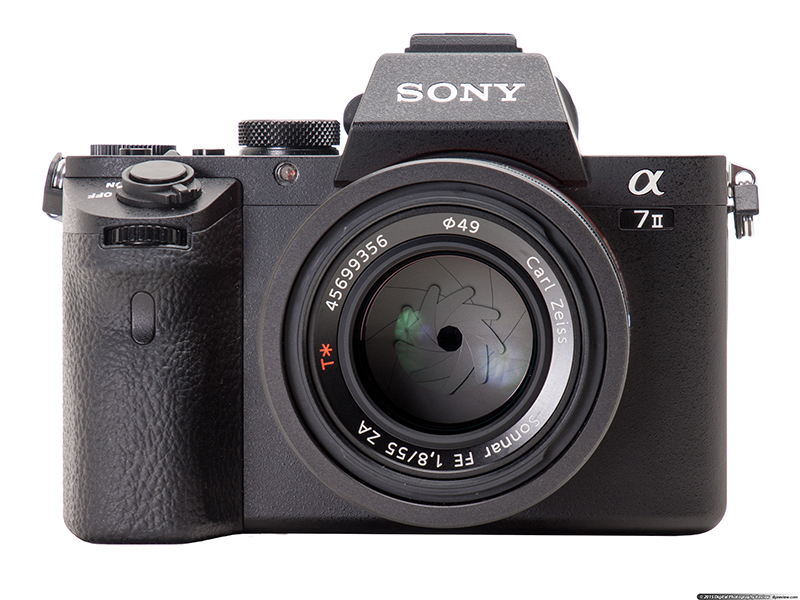
A7 II, a member of the mirrorless camera family with a full-frame, full-size sensor, was our review guest.













Özgür Çetin
One of the areas that the Japanese electronics company Sony has been involved in in recent years is cameras. The brand, which has various products in this field, also has models in the mirrorless category.
Producing one of the first full-frame models in the mirrorless field, that is, with a full-size sensor, Sony launches its products in this field under the A7 model family.
A Large Family
The A7 family is a large family that includes the A7, A7R, A7R II, A7 II and A7S models. Sony aims to appeal to photographers in different fields with multiple devices. Although all these product types can be a bit confusing, we should point out that there are not many competitors to the A7 family in the market. Because many manufacturers are not keen on producing mirrorless with full-frame sensors for now.
Our review subject, the A7 II, is a model that can be considered the middle member of the family.
24 Megapixel Sensor
Sony, which supplies sensors to many manufacturers (including brands such as Nikon), used a 24-megapixel full-frame CMOS sensor in the A7 II. Other basic features of the camera include image stabilization integrated into the body (5-axis), ISO that can be increased to 25,600, burst shooting speed of 5 frames per second, 25 contrast, 117-point autofocus, magnesium body, and 600 grams body weight.
The camera has a digital viewfinder and a 3-inch LCD screen that can be moved up to 90 degrees. Since it is a model with interchangeable lenses, you can achieve the usage experience you want with compatible lenses.
Lens Attachment
The lens with Sony SEL 24-70mm f.4 ZA OSS f.4 aperture that I used with the product is generally successful. However, the fact that the aperture is relatively closed and that it is a heavy lens creates some difficulty in terms of daily use.
Full-frame digital SLR models have f2.8 aperture options in this range. Of course, their price is more expensive than this model from Sony, but I think that when you buy a full-frame product, you need to open your wallet a little.
Still, the Sony SEL 24-70mm f/4 ZA OSS lens is sufficient for daily use. It also meets expectations in terms of performance and sharpness.
A7 II can be used with Sony's FE, E and A lenses (with adapter). You can also connect Nikon or Canon lenses to this device with adapters developed by some companies independent of Sony. So I can say that you will not have any problems with the lens.
Photo Quality
Sony continues the photo quality it offers in the A7 family in this model. You can take beautiful, clear and sharp photos with the help of many settings, manual touches and extra features.
Although the photo quality of the camera is sufficient, it produces more grain than it should at high ISO. Sony needs to work a little more on this issue.
A Little Heavy
The camera also feels like you're using a digital SLR at times. Because the body design is no different from a digital SLR model. This similarity also caused the device to be a little heavier than mirrorless models. Since the body design is like a digital SLR, it has become inevitable that it will be a little heavy.
In addition, the weight of the device increases significantly with the 24-70 mm lens. The weight of the device with this lens reaches 1 kg. This makes it a little difficult to carry on a daily basis.
Rotatable Screen
The screen used in the A7 II can move 90 degrees upwards and approximately 45 degrees backwards. In this way, this rotation function can be used especially for shots taken from the waist down. However, when you lift it up, this screen is not of much use.
I have another criticism about the screen: It should have been touch-sensitive. Many cameras today offer touch screen features. I think its absence from Sony is a deficiency.
Some people may not like the fact that the viewfinder is digital, but the optical viewfinder option in mirrorless models is not very common for now. It is not preferred because it increases the weight of the device.
Video Issue
In my opinion, video is one of the areas where Sony is best. The A7 II is no less a product when it comes to video, which I liked very much in an A7 model I used before.
The product, which can record Full HD 60 fps (60p and 60i) video, also supports XAVC S compression technology developed by Sony. In this way, 50 Mbps video can be recorded.
The speed of the product, which can also provide clarity during video recording, is very successful in this sense. A7 II, which can focus almost as fast as a video camera, has a sharpening speed that we cannot see in digital SLR models.
In addition to all this, headphone and microphone outputs are a blessing for video enthusiasts. Although microphone output is available on many devices today, headphone output is still a technology supported by a small number of products. It is a technology needed to listen to sound in real time, especially when recording videos.
5-Axis Anti-Vibration
An important feature of the camera is that it has 5-axis anti-vibration technology. In other words, in addition to the X, Y and Z axis, it also has the ability to prevent right-to-left and top-to-bottom vibrations (up to a point).
Although vibration cancellation is not very important in photography, it is a very necessary technology for video. You see the benefit of vibration suppression, especially in moving video recordings.
Wi-Fi and NFC
The camera features wireless network connectivity and NFC technologies. It is possible to use the device remotely with the wireless network feature. You can also transfer photos and videos wirelessly.
Battery Issue
The battery used in the product has a lifespan of 350 frames according to CIPA standards. That's slightly above average for a mirrorless device. However, if you are shooting in the field and especially if you are recording videos, the battery can run out very quickly.
However, like other members of the A7 family, the A7 II is charged via microUSB connection. This means that you can solve this problem with an external battery solution (used for mobile phones) that you can take with you in environments far from electricity. It is becoming more common for cameras to charge via microUSB. However, you cannot use the device while Sony A7 II is charging. This is a significant handicap. If Sony can overcome this, they will also overcome an important problem. Let me tell you.
Price and Preference
Sony A7 II, whose sales price was 7499 TL with a 24-70 mm lens on the date of our review (July 25, 2015), is not a very cheap product. However, any camera with these features is not sold cheaper. The cheapest full frame digital SLR price is around this area.
Sony A7 II is a product that can be preferred. It is a product that we can recommend especially to those who have expectations about video. The camera, which also appeals to those who want to take beautiful photographs, is above average in meeting expectations.
Sony A7 II is a camera that takes full advantage of having a full-frame sensor. The product, which does not have many competitors, challenges its digital SLR counterparts. Although it has many features that can compete with them, it needs to be improved in certain aspects.
PLUS
· Advanced video features
· Headphone output
· 5-axis anti-vibration
MINUS
· A bit heavy
· Photos are too grainy at high ISO
Specifications
· 24.3 megapixel resolution Full Frame CMOS sensor
· 5-axis anti-vibration
· 117-point focus system
· Bionz X image processor
· E-mount support
· 2.36 million pixel OLED viewfinder
· 3 inch 1.23 million pixel moving screen
· Full HD video recording
· XAVC S codec support
· Microphone and headphone outputs
· Wi-Fi and NFC feature
· 25600 maximum ISO
· Shooting speed of 5 frames per second
· JPEG and RAW support
· 350 frames battery life according to CIPA standards
7499 TL including VAT (with 24-70 mm lens)