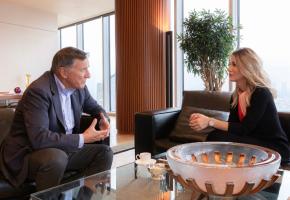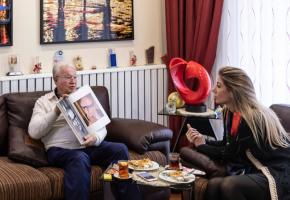





















The day we met Fuat Kozluklu was the day we commemorated Ara Güler's first death anniversary at his grave. Later, our acquaintance was strengthened with the PhotoMaraton meetings and my first hosting experience with him. Many of us already know him from his nightly bulletin on TRT Haber.













We had the opportunity to get to know him better through his live broadcasts on Instagram due to the Covid-19 outbreak. Fuat Kozluklu's deep knowledge of world and Turkish political history can keep you up until the morning. But now it's time to listen to his career story and opinions from the very beginning!
Interview: Nihan ÖZGEN
When did you start journalism?
I started working at Vision Newspaper in Malatya in 1982. I was working with my first teacher, İsmet Yalvaç. After a year of local experience, I chose to work in the national and then international arena. I made the first interview with the late President Turgut Özal after he founded ANAP. This interview I did over the phone was published in the headlines by the national press. That and a series of similar news stories had an impact on my Istanbul dream coming true.
I have now left thirty-seven years in the profession. In the early years, I worked as a reporter and photojournalist in print media. I have been on the radio and television side for the last twenty-nine years. I stepped into the world of television as a camera assistant and sound technician in a foreign television news agency. I worked as a war cameraman. Two years later, I returned to print media. I have been in front of the camera since 1998.
How do you think journalism should be done?
I have strived to be someone who respects his job and thinks, feels and implements the need to do this job very well. I think this is how it should be done! Unfortunately, our country is a place where the majority of people think of leaving by doing their jobs routinely. You can also observe this from a master who comes to your home. I try not to make my fellow students say "it's not worth it" at the end of the time allocated to me at the universities where I teach! Of course, I cannot tell them anything that will change the course of their lives in a short time. I don't have such a treasure or formula. But I try to emphasize that it is vital that they do something for the future of our country.
What features should it have to work in front of a screen?
One of the most important issues is that your expression and appearance are reassuring. A presenter who knows what he is presenting and knows his content keeps the audience hooked. The audience will quickly notice whether you are familiar with the news or not.
You are very comfortable presenting the news. It's like we're talking at home…
Thank you very much… Being a presenter coming from a reporting background may have added value. I like to explain things in a way that the other person can understand. If you are a presenter who knows every aspect of what he is reporting and who carefully follows the developments in his country and other parts of the world, you are among those who do their job very well. I would like to state that I am very lucky to have the opportunity to do my job as a reporter presenter under the roof of a very special institution like TRT.
What does one need to do for success, no matter what profession?
Most importantly, let them be human beings first, then professionals (journalists, photographers, doctors, craftsmen, teachers).
What about journalism?
It is important to stay away from hate speech in journalism. In the near future, those who cannot master the internet and new media tools will not be able to do this profession. Knowing English well is now a must for everyone. In fact, there is now a generation that speaks at least two foreign languages. It is necessary to read a lot and to have a culture that will dominate the world and country history of the last century. The knowledge about the past and present of Türkiye and the surrounding countries is very important. First of all, it is necessary to have a general knowledge of the history, political, cultural and social structure of our country.
We also followed you from your live broadcasts on Instagram during the Covid period. What impact do you think these publications had on this process?
From a psychological perspective, I think Instagram live broadcasts have been like a lifesaver for many people. Due to the impact of the coronavirus, most of the artists broadcast live and gave mini concerts in their own homes to support "social distance". This trend, initiated by world-famous names, was immediately adopted in our country.
What did journalism bring to you?
I saw part of the world and met people of different languages, religions and races. But I was disappointed to see that there were not many people who aimed to live and die in peace, without destroying each other, which I idealized. My aim was to ensure that my news, photos or recorded videos would contribute to a conflict-free life. I even risked my life for this cause, just like many messengers around the world who think like me. Unfortunately, I dramatically experienced that our efforts for this purpose were of little use, and I did what many journalists do and bowed to the brutal facts. Let me just state that the language of my news is the language of peace! I do not discriminate based on language, religion, race or gender! I continue to fight for universal values, and I will continue to do so...
What advice would you give to those who want to do this profession?
They should equip themselves in digital journalism. Our profession is a learning machine. I have been learning for 37 years. I read books from the medical world, as well as law books... In order to be informed, one must first read and learn a lot. Let them learn one or two languages other than English. Most importantly, let them be human beings first and journalists second. The need for journalists who are free from hate speech has increased significantly day by day. In the near future, those who cannot master the internet and new media tools will not be able to do this profession. A culture that will dominate the world and country history of the last century is essential.
Were there any comments or advice you received from your journalist friends and elders?
When she was writing for Milliyet, the late Duygu Asena referred to me as "Fuat Kozluklu, who showed reporters how to be a reporter" in her column... One or two of the most valuable elders I found thanks to my profession is Nazım Alpman; He wrote about me in one of his articles: "Fuat Kozluklu was born from the womb of his mother, Remziye Hanım, as if he were a "messenger". He could have given his life for the news. He had already done so several times." He explained it with these words.
How lucky am I! How many people in this profession give that kind of badge of honor to another? Let me list a few more examples: A doyen like Mehmet Ali Birand, in his interview in the 1999 to 2000 issue - if I'm not mistaken, it was Vizyon magazine - listed me among the 5-6 names that will be mentioned in the future of the Turkish television world... Another doyen of the profession, Uğur Dündar, included me among the names who conveyed the tragedy with a journalistic skill at Western standards in his column in Hürriyet on the fifth day of the 17 August 1999 Marmara earthquake. He also made a special and very meaningful emphasis by saying, "Not only does he have nothing left behind from his colleagues on the world's leading TV channels, but he has also reached an extraordinary level of success from time to time."
These are very flattering. We congratulate you too. Going back to today, how is the Night View program on TRT Haber going?
Night Gaze is a three-year program and thankfully we have a valuable audience. We are enthusiastic, exciting, mischievous, sweet, inquisitive and hard-working. I am someone who believes in team play. This is not a success achieved only by me.
You stayed in the USA for many years. So why did you want to return?
A person wants to have children in the place where he was born and for his children to have the same identity as him. It is also necessary to be there for parents when they get old. People who stay abroad for a long time may have problems with their sense of belonging. In other words, long stays exceeding ten years affect a person's sense of identity and belonging. In particular, factors such as the time spent outside and how often one visits one's country can trigger this feeling.
This is my beautiful homeland, my favorite living space. I can't live anywhere else. I have encountered some adaptation difficulties. I can only swallow.
My journalism adventure began in 1989 abroad and in 1991 in the USA. It continued until 2006. I returned to Turkey twice in 2000 and 2003, but due to the adaptation problems I experienced, I found myself in Washington again. My return to Turkey in 2006 became permanent. Although adaptation problems continued, everything went well until May 2014.
How did life go on then?
Afterwards I became unemployed. Those three years were like a nightmare. All the balances of my life were turned upside down. I saw my so-called colleagues enjoying my unemployment. In those three years, I received valuable material and moral support from a few colleagues who had never crossed paths with me. I will always be grateful to them. I held on to life thanks to those who sent me money and my good friends who tried hard to find a job in the media. But my mind was on my profession, which I loved very much. After returning to Turkey, I realized that I had been dreaming in vain about being given a role that would allow me to use my international experience and skills in my country. Today, I have managers at TRT Haber who value and respect my years, experience and knowledge. No matter what the conditions are tomorrow, even if the TRT page is closed, I will continue to say this. My professional background, that is, my CV, found a response on TRT for the first time.
You have an interview in which you say that you started reporting news on TRT while you were a taxi driver…
About three weeks after I started driving a taxi in 2016, my dear friend, Head of TRT News and Sports Broadcasts Department Yaşar Taşkın Koç, offered me a job as a presenter. I was behind the wheel when he called. I was able to talk for half a minute. His offer was a great opportunity. I couldn't talk about the details, my throat got stuck and I started crying. I am always grateful to him and those who supported the process of making this happen. I am someone who loves my job and does it with love. Money doesn't matter a bit. It is enough to earn enough to sustain my life on a minimum basis. In the words of Hasan Özhan, who was one of those who supported me financially and morally during my times of trouble and who was also the friend of my son Burak and who knew my childhood, "I thank God for overcoming the risk of becoming rich and famous."
You have an interesting moment with Turgut Özal. You shared it before, but our readers would be curious too.
May God have mercy on him. Mr. Özal was a colorful and self-confident politician. For years, I pursued him both domestically and internationally, writing the news and taking photographs. On October 28, 1985, I held him by the neck and looked at the brand of his jacket!
When Özal was Prime Minister, Bijan, known as the boutique of kings, counted him among the celebrities it dressed. And I said, "Is it true?" When I asked him, he said, "Check my jacket, Fuat," and allowed this picture to be revealed. And we, two Malatya people, were on the headlines of all the newspapers the next day! While he was entering the political scene, I had just stepped into the media world... Year 1982, Malatya.
Who is Fuat Kozluklu?
Fuat Kozluklu was born in Malatya in 1965. He started his journalism career in Malatya in 1982 at the local daily Görüş Newspaper. He continued his career at Cumhuriyet Newspaper since 1983. He was a reporter on the founding of Sabah Newspaper in 1985. He returned to the Republic in 1989. While working in Turkey, he also worked as a photojournalist for international news agencies.
started his work in the television world in 1990 as a camera assistant at the Independent Press Agency (BBA), which followed the developments in Turkey and the Middle East for foreign television channels, and broadcast news about the Gulf War from the north of Iraq.
represented Cumhuriyet Newspaper as well as TRT, Star TV, NTV, TV8 and Power FM in Washington, the capital of the USA, between the autumn of 1991 and 2006. Between 2002 and 2005, he worked as a reporter, presenter and editor at the Voice of America Radio and Television Turkish (VOA) service in Washington. Kozluklu returned to Turkey in 2006, and in 2007, he hosted the night segment on the newly established news channel 24, in the "Moderator Gece" program. In June 2008, he presented the main news bulletin on ATV, one of the four major television channels in Turkey, for a year. Since the beginning of 2017, he has been presenting the news program Gece Bakı and special broadcasts on TRT Haber.
Among his notable news in television journalism, it is remembered that he was the first journalist to announce to the world the news that the terrorist organization PKK leader Abdullah Öcalan was captured and brought to Türkiye, and that he reached the region about two hours after the earthquake of the Marmara Earthquake on August 17, 1999, and conveyed one of the biggest natural disasters of the 20th century to world television on live broadcast.
Among the remembered historical news is the revelation that Turkish diplomatic passports were given to Iraqi Kurdish leaders Celâl Talabani and Mesut Barzânî in 1992, upon the instructions of the then President Turgut Özal.
witnessed the 1991 Gulf War and the invasion of Iraq by international forces led by the USA in 2003. He was one of the first journalists interviewed by General Pervez Musharraf, who seized power in Pakistan with a coup.
In his professional life, he witnessed coups, wars, migrations and natural disasters such as earthquakes from dozens of countries of the world, including Afghanistan, Bosnia-Herzegovina, Armenia, Ethiopia, Iraq, Iran, Kosovo and Pakistan, as well as many international agreements; He interviewed prominent figures of historical events.
He was awarded as the successful reporter and presenter of the year by many professional organizations. He also owns the news sites sansursuz.com and malatyahaber.com.