



















Dukhas are ancient Turks living in the mountainous region of northern Mongolia, on the Russian border. The Dukhas are just one of the peoples left behind by the Turks during their hundreds of years of migration from Central Asia to the foothills of Europe... (Dukha = Duha)













Text: Efe TANAY
Instagram: @efetanay
Photos: Esmedekh ALTANGEREL
The Dukha lived in isolation from the rest of the world until the Mongolian government gave them identity in 1952, and had contact only with the Tuvan Turks who now live in Russia. This nomadic hunting community, which continues to live in the same way as the Turks lived in the steppes of Central Asia, still maintains the simple and natural culture of the past in an incredible way.
Time moved slowly for them and preserved all the beautiful human emotions. As you know, while what we call modernity brings money and greed, it also continues to destroy beautiful human emotions.
Visit to a Dream World
I was able to reach the Dukhas after a difficult 3-day journey from the capital Ulaanbaatar. Every event I experienced while I was with them was a story in itself.
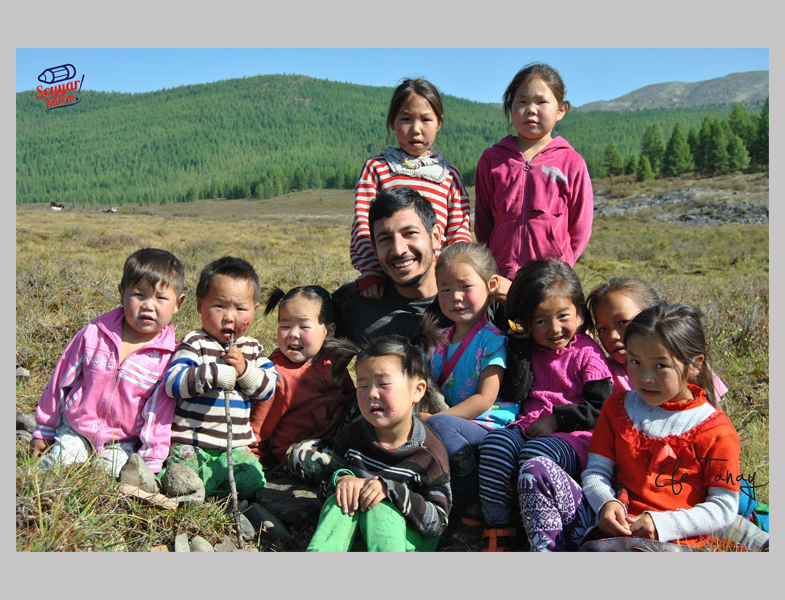
My most precious memory was playing with the children. My guide and companion Ese and I joined the children playing in the middle of the camp. It was not possible for me to communicate without Ese, because among the young children, almost no one knows Dukha, which is very close to Turkish, but adults speak Dukha.
Children everywhere in the world are pure and clean, but there was a more special simplicity in the children here.Being like one of them among them gave me a unique happiness, even if only for a short time. The stones on the ground and the small twigs we found around became our toys. It was such a beautiful moment that I wanted to make them happy, so I grabbed a chip from our tent and returned to them. In my opinion, in order to be fair and equal, I divided the chips among all of them. Because my perception developed in the city made me think that some of them might play a trick and want to get more than others.
During our stay there, I was distributing the things I brought with me to the Dukhas. Because I heard that they could not find hygiene materials on the mountain, so I filled my bag with such products. Since we were going to ride horses through the forest to reach them, I could only take a small bag with me. When I realized that I could fit 3-5 more soaps in my bag for each spare change of clothes I took out, I gave up taking spare clothes with me. The chips that were the subject of this incident were one of these items that filled my backpack.
Children learn bad habits from those around them. I cannot say that I see the slightest bad behavior among the Dukhas, everything is about sharing and equality. Since there is nothing to set a bad example for children here, they grow up as decent individuals. The world we define as modern is full of bad examples. In this place, which some would describe as the top of the mountain, there is no such thing as being bad. In other words, being white is not a privilege in a place where everything is white.
While I was trying to distribute the chips evenly, I noticed that one of the children took a little too much. But how can you say "no, you took too much" to a child who holds out his palm to you? In my opinion, this kid was one of the cutest ones. While I was busy sharing, I didn't realize what they were doing with the chips they bought. A few minutes later, Ese showed me that many children, including the one I thought had taken too much, had put the chips under the stones where they played house. While the game was going on, I was trying to watch the children carefully to understand them better. One of the children lifted the stone that the other child used as a house and took two chips from it. This house belonged to the girl who I thought bought too many chips. Like me, he saw the other kid taking his chips but didn't say anything. The girl, who I thought had taken too much, had all her chips while the others shared them. If he already bought too much, he bought at most 3-5 pieces too much, but obviously he didn't buy that for himself. I have read that hunting and gathering peoples are sharing and never take more than they need, but it seems hard to believe until we actually observe something so contrary to the order we are used to. I witnessed this sharing in everything I read about them and every moment I stayed with them.
While we were experiencing all this with the children, a father, seeing the excitement among the children, approached us with his horse in front and his child's horse behind. Ese said, "They ask, 'Efe, can you give some chips to the little boy on the horse?' Seeing such a small child on a huge horse was already an incredibly sympathetic sight, and when I learned that he came to us to buy chips, he looked even cuter. I think I would have been devastated if I had run out of chips at that moment, but there were still enough for him. The best thing was that one of the children noticed the situation and acted before me and gave his own chips to the child on the horse. So I distributed some more of the leftovers to the boy on the horse and the boy who shared his own chips. I was still trying to get justice in my own way. There was something very interesting in this little cycle, the boy who gave his own chips to the boy on the horse was the boy who took the chips from the girl who I thought had bought too many chips. This incident revealed again how wrong my definitions of "less - more" were.
However, shouldn't each chip be very valuable? After all, they were all children and they were 2 days away on horseback from the nearest market. Maybe they had never eaten chips before, or who knows when they would eat them again... Each piece of chip should have been more valuable because it was hard to reach. This is how my economist mind, developed in the capitalist system, interpreted it, but obviously even if I gave it all to a single child, they would share it fairly. In fact, justice could not mean that everyone received the same number of votes; equality is not justice. A situation that we misunderstand in the world we call modern is "equality and justice". A pack of chips taught me what justice, equality and love are in 3 minutes.