



















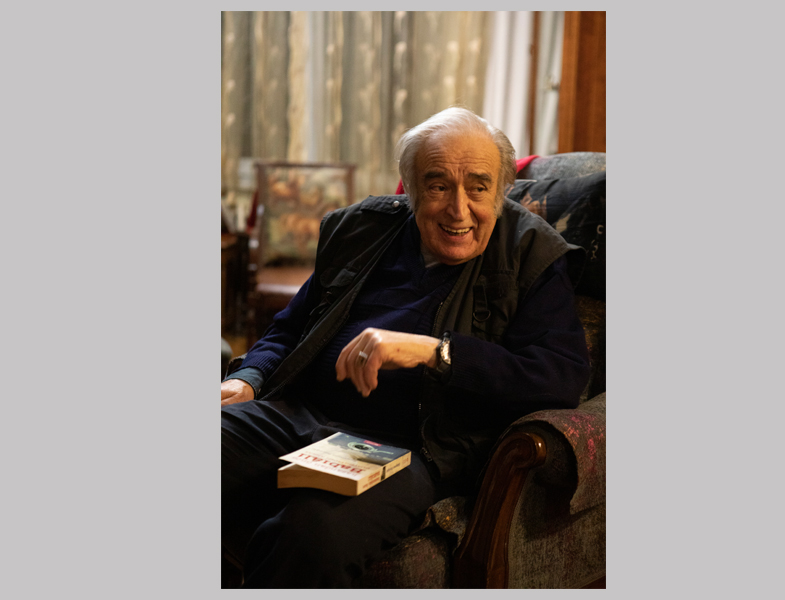
Konuksever, who was fired one by one from the newspapers he worked for due to his straightforward character, told GezginFoto about his action-packed years. Student protests of the 1968 generation, Bloody Sunday, Deniz Gezmiş, 1974 Cyprus Peace Operation... Our hearts ached as we listened to the events where sometimes spiritual and sometimes physical pain came to light... We are glad that such men exist!













Interview: Nihan ÖZGEN
Interview Photos: Adem MELEKE
Commemorative Photo: Fuat KOZLUKLU
Brother Ergin, you have seen and experienced a lot. I want to ask one by one. Let's start with the student events of the 68 generation. When did you meet Deniz Gezmiş?
I met Deniz in 1967. He had just entered Istanbul University Faculty of Law and was rising rapidly within the student movement. Lawyer Bozkurt Nuhoğlu introduced us. When we took our first photo together, we laid the foundation for a friendship that lasted for years. While he was banned and illegal, he spoke only to me at METU. I reported on their every action. I even helped hide it. He always trusted me as a journalist. I have never abused either. We understood and loved each other very well.
Did you know that you would never see Deniz Gezmiş again when he took the most shared photo of Deniz Gezmiş in a fur collar parka?
I saw Deniz months later, on March 17, 1971. I wanted to speak a few sentences, but they quickly took him away. I could only press the shutter button. I actually said goodbye to Deniz with the photo I took. No one could have known that he would be executed. Even himself... He would have been tried anyway, spent time in prison, and returned to us. That day he stood tall in his green parka. When I look at this photo now, I get a lump in my throat. I wish it hadn't happened…
This is a very heavy event for you. He is your close friend and you took his photo for the last time before he died...
On the night of his execution, we waited at the Ankara News Agency office with Deniz, Hüseyin and Yusuf's fathers until the morning. Actually, we expected a miracle. But unfortunately, we received Deniz's body in the morning. I never forgot him. His photograph has been used countless times in many places. It became a symbol of the revolutionary movement.
War correspondent Ergin Konuksever is a reporter who followed the Cyprus landing with the Turkish army moment by moment. Konuksever, who recorded the step-by-step operations on the tanks, was injured in this difficult mission and became a veteran. He says that the Cyprus Peace Operation is a glorious operation of the Turkish army. Konuksever, who proudly remembers that the nation embraced the Turkish soldier, states that the intervention in Cyprus was made with the courage shown by the Prime Minister of the time, Bülent Ecevit, and uses the phrase "Conqueror of Cyprus" for Ecevit.
Brother Ergin, we would love to hear the Cyprus story from your words.
When it seemed certain that a war would break out in Cyprus, I went to Mersin and on the morning of the landing, I boarded the ship and set out for the island. Everyone on the ships was looking forward to getting to the island. The morale of the soldiers was good. Before the landing began, prayers were read and a group prayer was performed.
As soon as we set foot on the island, we faced attacks from the Greeks. Our people also responded to them. We had a few martyrs. They were buried right under that hillside.When we arrived there, Commander Karaoğlanoğlu was also martyred.
On the morning of July 20, I took part in a tank battle on the first day of the second phase of the Peace Operation in Cyprus. That day, I was in First Lieutenant Ersel Kayan's tank. Caught up in excitement, we broke away from the convoy and entered Famagusta. Later I learned that we were the first to enter Famagusta.
That day, I was going to send the films of the photographs I took during the tank war to Adana and from there to Istanbul by helicopter, which would take off in the evening. Shortly before the helicopter took off, my colleague Adem Yavuz and I were looking for a vehicle to take us around Hamitköy. When we heard that the headman was going to take a pregnant woman to give birth in his car, we got in that car and set off.
While we were traveling with a tank in the morning, we were about to pass through an area that I learned had not been taken by the Turkish military yet, so I warned the driver about security. But he didn't listen to my words. I said to Adem and Cengiz (Kapkın), "Get behind the wheel, otherwise I will throw this guy out of the car." Cengiz tried to calm me down. Before I could say that he was leading us to death, we came under a volley of fire after 300 - 500 meters.
Even though he served in hot wars such as the Arab-Israeli war, the Iran-Iraq war and recently the Iraq-US war, Cyprus is of great importance to him...
Have you been shot?
The Turkish flag was hanging on the windshield of the vehicle. When the windshield was smashed with a stick, I immediately lay down in the vehicle. While I was lying down, a bullet entered the driver's mouth and he collapsed on top of me.
When the car stopped, I waved my camera out the window and shouted "journalist", but as soon as I got out of the car, I was exposed to a volley of fire and was shot in the arm. Then we learned that the Turkish positions recognized me and tried to protect me with fire so that I could pass to that side.
So, how were you treated?
After the attack, a Greek took me to a building. He gave me first aid. “Who are you?” he asked. When I told him that I was a journalist, he said, "I am a journalist too, but unfortunately we are enemies now." he said. Of course, blood is gushing from my arm. The boy went and brought a towel and told the people next to me to press it on my wound.
I was starting to get weak from blood loss. An armored car came and picked up Adem Yavuz and me and took them to the hospital. While they were trying to get me into the hospital on a stretcher, a group of people coming out of the hospital started punching me, saying "Turks have come, Turks have come." Then a man with a cloak on his back came. He was a doctor. He chased away all those who punched me."I am a doctor, I took the Hippocratic Oath. You are under my protection. No one can do anything to you." he said.
Did you know that Adem Yavuz would die?
No, nothing had happened to Adam until that moment. He was standing. I even asked for forgiveness while I was going to the surgery. Just in case I die or stay... I entrusted my family and children to him. Two hours after the surgery, they brought Adem on a stretcher.I thought he was injured too but didn't notice.But Adem did not speak at all during the 15 days he lay there. He was just moaning. When he seemed to come to his senses a little, I asked him what happened. It turns out that while they were carrying me on a stretcher, someone shot him in the stomach in the hospital garden. Couldn't fix it. The Greek Doctor operated on Adem 5-6 times, but unfortunately we could not save him.
The doctor is a very loyal man. Did you ever meet after that?
I owe him my life. His son came to Istanbul. I took it with my son and we took him for a ride. He also had a piece of land left in Northern Cyprus. I helped him get his money.
So, were you able to recover in that hospital? How did the next process proceed?
They took me out to extradite me to Turkey. But they took him to Limassol, another city of Cyprus. They put me in prison in a military garrison there. A place resembling a large gymnasium was filled with Mujahideen and Turkish prisoners. A lot of men, all standing... I was locked in a cell. My wound burst there and my fever rose. They had to take him to the hospital. I stayed in a hospital in Limassol for 4 days. Then the Red Cross came and brought me to the Turkish section.
What are your thoughts about the operation?
Peace Operation was a glorious operation of the Turkish army. Everyone embraced the Turkish soldier. Ecevit is the conqueror of Cyprus. Ecevit made that decision. He dared and succeeded. I went to Cyprus again 2 years later. Cyprus is important to me.
Were you able to complete your duty as a journalist?
They took the best photographs I took during the operation when I was injured. The most beautiful photographs were taken on the day of the operation. Then they appeared in the world press. It was a tank operation. I wanted to take those photos but they didn't give me them.
It's a tough job. What advice would you give to war reporters?
When you work as a war correspondent, you have to risk everything. Your chances of protecting yourself are limited. A mortar falls next to you, a cannon falls. It is necessary to do the best you can and protect yourself in the best way possible. I have never been afraid of war and conflict. I watched the Arab-Israeli wars on site before the Peace Operation. After Cyprus, I also went to the Iran-Iraq and Iraq-US wars.
Who is Ergin Konuksever?
was born in Samsun in 1937. He graduated from Istanbul University Journalism Institute. He started his journalism career in Vatan Newspaper and continued in Yeni Sabah, Hürriyet, Günaydın, Cumhuriyet, Milliyet, Akşam, Tercüman, Bulvar, Hayat Magazine. He worked at BRT. Konuksever, who was one of the first to set foot on the island of Cyprus with the marine infantry units that landed in Cyprus in 1974, served as the press spokesman for Staff Colonel Talât Aydemir. He has a press honor card.