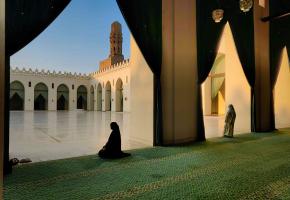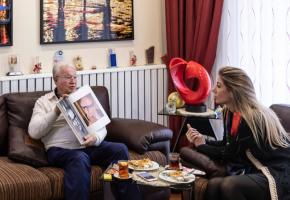





















When a person decides to take photographs, he makes a record of everything that interests him. The day a person understands why he takes photographs, he tells people visual stories.













Text and Photos: Gilcan Mete DELİBAY
When my eldest daughter was a freshman in high school, she stood before me and wanted to chat with me about Sigmund Freud's theses. I said this because it did not seem right to me that a young person at the beginning of his life would discuss these issues with his father, based on the analyzes Freud put forward with his years of knowledge, experience and cultural background. "We will talk about these issues with you, but first have fun, save and live as your age should! Then, when you have half of what Freud saved, let's sit down and talk."
My daughter graduated from university with a degree in psychology and a master's degree in clinical psychology. If he comes to me and says let's talk, reminding me of what I said years ago, I think I will keep silent by saying "I prefer to listen to things I don't know about." Now, the best thing I can do about a subject in which my daughter has so much knowledge is to benefit from her knowledge.
The reason I tell this dialogue is to draw attention to man's quest to know himself. A person's search for self-knowledge, his effort to know himself, goes through the effort to learn by accepting what he does not know. Man's search for himself; It is not a completed process, but a process open to re-evaluation. This interpretation and evaluation is also a way of seeing. This quest, which usually begins with the hope of ending but reveals itself as a never-ending process, is important in terms of shaping the relationship that humans establish with the universe in which they position themselves and other people.
From the moment our lives begin to our teenage years, we are constantly interacting with and exposed to all kinds of environmental factors. In this process, all our vital attitudes, behaviors and beliefs, such as what is right and wrong, what we should do and what we should not do, are loaded with cultural transfer. After a certain age, people begin to find themselves and search for themselves as a result of emotional and interactional processes within themselves.
In my article titled 'The Evolutionary Pains of Photography' published in the 28th issue, I talked at length about the most important stage in the photographer's process, which starts with the camera, is his search for himself after education. Having reached this stage, the photographer's rebirth begins with the photographs he takes with his own choices and emotional connection. This process continues in parallel with the human being's search for himself and his desire to find himself.
Philosophia; It means love of knowledge, love of wisdom and knowledge, fondness and passion for pursuits, quests and pursuits that require hard work. The photographer's way; As the desire to know continues with work, tracking, search and passion, the effort to search and find oneself continues.
While the photographer increases his intellectual knowledge, he begins to write stories through the photographs he creates with his soul, instead of the components he creates by observing life. As self-awareness increases, photography becomes a means of telling rather than a means of recording. That's when photography reaches its literal meaning, that is, writing with light.
Strangely enough, wherever we look in the universe, we see objects or living things other than ourselves, unless there is a mirror in front of us. In fact, in these images that we selectively look at, in a way of knowing ourselves, we establish connections with our past, our current feelings or our future. According to the History of Western Philosophy, our effort to find ourselves seems to have begun in the era of Thales and the Seven Sages and has continued until today. Although the effort to know oneself is sometimes used in the sense of knowing one's place, it is mostly used to mean what a person is in order to transform himself into a better one, in other words, what his essence is, what needs to be done in order to have the opportunity to take care of himself by distinguishing what belongs to his essence and what does not belong to his essence. This effort to know oneself, created by a person who does not see himself in the field he looks at, by establishing a connection between everything he sees, is also an effort to understand and explain with the definition he has achieved.
When I set out on the road with a friend of mine who I love being on the road with, I realized that my connection to the road was actually a journey to myself. In fact, what we call the road is nothing more than an excuse for the journey towards oneself. Because everything new we see on the road completes a missing piece within us. It makes additions and sometimes changes in our effort to find ourselves.
Isn't that what our photography journeys are like? A change that goes parallel with getting to know ourselves... After a while, we start to dislike shooting everything. Explaining in photography takes precedence over creating. Aren't more and more sincere, more meaningful, more emotional photographs taking precedence over photographs based solely on aesthetics and rules? How can one explain the pleasure of pursuing our own shots instead of pursuing subjects determined by others! Reaching one's essence in photography, just as one finds oneself, emerges as our most fundamental pain over time.
We are exposed to an incredible number of photographic images every day. While passing through all these photographic images with small movements of our fingers, we come across such a photograph that our hearts and souls are captured in an instant. The emotions it makes us feel when we look at it for a long time, and the bond we form with the past or the future, capture us. Not every photo can be appreciated at the same level by everyone. Every photo story with a strong narrative language will definitely find hearts to be read and valued.
History is full of scientists and artists who were rejected and subjected to severe criticism because of what they said and thought. Popular culture reveals itself in the world of photography as well as in every aspect of life, and photographers spend time and effort in pursuit of popular photographs. However, history shows us that formations that are themselves and express their thoughts reach the value they deserve over time. Instead of photographic frames indexed to the number of likes of our age, works that have reached the expression language created by the photographer's discovery of himself cannot necessarily be met with the same appreciation or interest. Even though time is sometimes early, sometimes late, it always crowns everything that is truly original and has gained meaning.
In this issue, I did not want to write an article containing some technical information about how to take portraits, lighting, winter photographs and autumn photographs. It is possible and easy to achieve technical shooting skills with a little effort. The difficult thing is to make an effort to find oneself and to write stories with photographs at the end of this search.
The poem "I WAS BORN IN THE DARKNESS", which is attributed to Mevlana but whose author is unknown, describes man's search for himself very well. Photography actually takes its place in our lives as a document and a part of our search for ourselves as much as reality. Sometimes we reach a little more of ourselves through the images we choose when taking photographs. Sometimes we recreate ourselves with the images we choose.
Socrates says the following in one of his 'Notes of Insanity', which he wrote to his friends:
To my friend Georg.
After discovering me, finding me wasn't such a tricky thing at all. The hard part now is losing me.
Dear friends, look for yourself, look for yourself in the photo. Express yourself with your photos. If you think you've found yourself, please don't lose yourself and don't give up searching.
Now, I will sit with my daughter, the most valuable asset of my life, and listen to Freud from her. I am aware that I do not know enough to learn to find myself from a life that is mine.