



















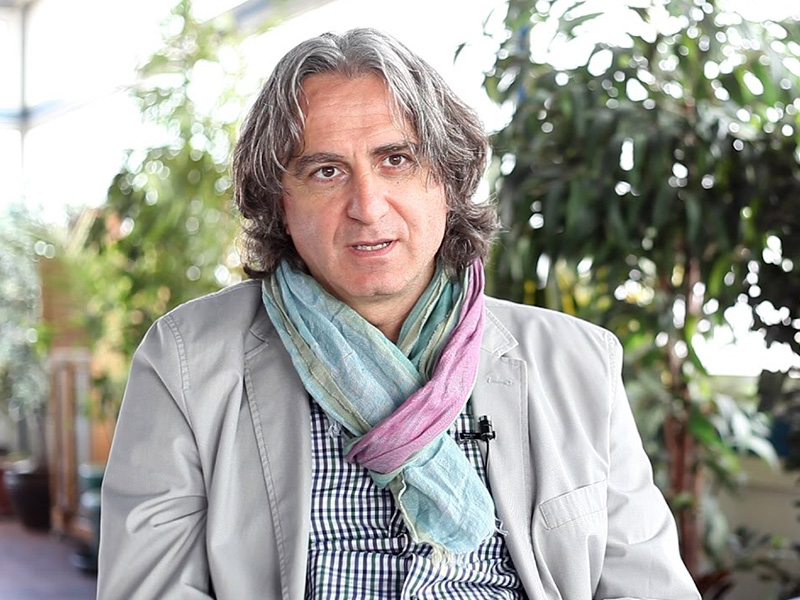
From Businessman Necip Yanmaz to Niko Guido, who is attached to photography with love. Those who know him know, but let me give a brief explanation for those who don't: Niko Guido is actually a Turk! His name is Necip Yanmaz. But he looks like a Greek from afar, right?













When I met him a few months ago and wanted to interview him, he was going abroad, he is a very busy, very active person... When we talked later, we agreed for October 7th. He had organized a boat tour that day and they were going to hold the İzzet Keribar Bosphorus Photography Cup with photographers. He welcomed me with his smiling face among a crowded group at the Kadıköy Ferry Pier in Beşiktaş in the early hours of the morning. During the day-long boat trip on the Bosphorus, I occasionally missed him from the crowds, even if only for a short time, and immediately asked him what I was wondering about. In front of me was a man who explained himself, his feelings and his work in a very fluent language.
Interview: Nihan Özgen
Photos: Niko Guido
Can we meet Niko Guido?
I graduated from Galatasaray University and studied engineering at Boğaziçi University. I was guiding at that time. To make it easier, the French call me Niko. Guido also means guide. I did not do engineering after university. I have always dealt with tourism and trade… I did my own business. When I turned forty, I got bored, like many people get bored... And I paid more attention to photography. My whole life has been photography. Since 2006, everything has been photography!
Apparently you don't have another job life...
None. My day and night, my photography 24 hours a day! My current life oscillates between photography, education and travel. I earn much less money, but I am more peaceful and enjoy life. I have no interest in becoming “million dollar rich”. I think the greatest wealth is memories, and frankly, I collect memories. That's why I'm a very rich man!
You said you have never done engineering, but I think you use an engineer's perspective when taking photographs...
I don't know about aesthetics, but I think every job I do definitely contributes to me. The guidance I gave during my high school and university years also made a significant contribution. The engineering education I received also contributed. But I honestly think that my biggest chance in terms of my photography career is that I chose photography as a profession at the age of 40.
Why is it important to make this choice at age 40?
If I had started at the age of 20, I would now be a photographer with 30 years of experience. But I'm open to anything right now. My brain is virgin and my excitement is high! I believe in love and excitement in photography. Therefore, photography as a profession is actually new for me. And in that sense, I feel very young, I see this as an advantage. Because I have a shy nature. If I had been doing photography for 30 years, I think I would have quit right now.
So, you will move to another field in 20 years, right? (Laughing)
It can happen, anything can happen at any time. (We laugh)
“Every person needs to be passionate about something.”
After what you told me, it doesn't seem like you'll ever quit!
Jokes aside, I don't think of quitting, because truly every person needs to be passionate about something. What I am currently passionate about and in love with is photography. This is a joy of life, this is happiness, it means feeling your blood flowing through your veins. If you are used to photography, you cannot live without photography!
Now wait a minute, you made a very strange description. I'm trying to understand... Are you talking about the pleasure of capturing an event somewhere and shooting it magnificently?
Let me explain it this way: Photographers are divided into certain categories.I'm talking about it in terms of pleasure... Some of them get incredibly happy from preparing the photo, going to that place, being in that place, taking the photo, pressing the shutter button. And the moment of pressing the shutter is an orgasm for them. Then, whether he shared it or not, whether he processed it or not, is not very important. For some parts, photography begins after you press the shutter button. In other words, after the photo is revealed, he enjoys processing it, sharing it, being liked, receiving "likes" on social media, and having everyone say to him, "You are great, brother." One section also enjoys it all, from beginning to end. From what I've told you, I think I like the first episode more. But of course, sharing, being liked and appreciated are good things.
Why is sharing important?
I tell something with my photographs. Photography is a language like other languages. Painting is a language, like English, French and music. It is necessary to learn this language well, but if you do not have anything to express with this language, there is no point in learning that language.
It is very important that I tell something with my photographs. If I can't explain it, it means I'm stuck there. In order to say something, it is necessary to be fed. Of course, this nutrition is not just about photography... It is necessary to feed from the world.
Like?
For example, after the Haiti earthquake in 2010, I went to Haiti as part of a UNISEF project. When I went there, 200 thousand people were lying underground. I worked there for 15 days and this period affected my life greatly. Of course, it also affected my photography. While I took mostly nude photographs in 2006, now I take more documentary photographs.
So you are saying that one has to be loaded with emotions...
So I'm saying I need to be able to fill the bottom. More importantly, I have to be saying something. Nowadays, perhaps billions of people take and share hundreds of billions of photos every day. They can easily take and share photos, especially with phones. But the world has now turned into a photo dump. Photos that have no meaning and do not explain anything are circulating on the planet. Among them, those who can really tell something are valued. This is my advice to friends who are new to photography: Try to explain something!
“Nude is not something that can be explained in the minds of the people of our country!”
You said you were shooting nudes. Does the name Niko Guido have a story related to nudes? Because, as you know, it is not a very accepted field in our country. And maybe you needed a nickname.
When I started shooting nudes, I was in business. I was dealing with trade and tourism. More than a hundred people were working with me. Also, as you said, nudes are not something that can be explained in the minds of the people of our country. The reason for all this is that I wanted to continue photography with another “nick name”. I didn't want to mix my photography with my business. Maybe I would have done the same thing even if there were no nudes.
Meanwhile, Niko Guido passed in front of me. Then, of course, there was no turning back. Niko Guido is going crazy. I'm trying to follow him too.
How beautiful! So, how is the interest in you from abroad? Could they think you are a foreigner?
Being Niko Guido has its advantages and disadvantages. You can be accepted much more quickly, especially abroad. As a name, you don't have any difficulties when you meet because it is easier for them to say. This is an advantage. The downside is that everyone thinks you are really Niko Guido and are disappointed when they find out your name is not Niko. “So, aren't you Greek now?” like… I have many memories like this. People seem to prefer me to be Niko Guido, I don't know why...
But it was a concept. It's a brand. Of course, there will be a momentary disappointment when you suddenly say that that brand is actually something else, right?
Frankly, the photography market in Turkey is a bit strange. I'm not really in that market. I don't want to go into it too much because it's like a boiling witch's cauldron. It comes to my ears sometimes. Some rumors such as "If he hadn't named Niko, this wouldn't have happened in life"... Maybe, but how could I have started with such an intention from the beginning? 10 years ago I didn't dream and act on this. It started like this, it continues like this... There is nothing I can do. Therefore, I don't care much about such things...
“Photography of the serotonin hormone secreted by social media”
Speaking of Turkey, I would like to talk a little about photography in our country. So there are many students, they are studying in photography departments. Is this really enough? Or trips, international festivals such as FotoIstanbul… Are all of these enough? There are also scattered perspectives in the field of photography in Turkey. How to put all this together?
I think the interest in photography in Turkey is great! Compared to other countries I have visited, there is incredible interest. This is happy. But it seems a bit messy. In other words, photographs are taken not for a purpose but to save the day. The pleasure of taking photographs for a purpose is completely different.
We have a photography project we did last year, carried out by 26 photographers. It is a project that I manage and advise: Istanbul 365 days. This is a first for Istanbul. 26 photographers shared the days and took photos in Istanbul every day. For example, a book consisting of project photographs was launched at Fotoİstanbul. So where do I come from: Those 26 photographers took photographs for a purpose, day and night, rain or shine, for a year. They enjoyed it. And now they are getting paid for their efforts. Next year, exhibitions will be opened at French Culture in Istanbul and Miami. When you pick up this book, you will see that it was made for a purpose. What is the purpose? To create the memory of Istanbul and leave it to future generations. Imagine, 100 years from now, when someone buys that book, we won't be alive! But we will still be in that book. This is a very happy thing...
Now they are trying to do something to sort out this mess. Unfortunately, in Turkey, everything is expected from municipalities. Competitions are held constantly. And today, such artistic activities are always evaluated by companies as follows: "What will this bring to me, how many people will see this, how many people will "like" it, how many people follow you?" Nowadays, your photography is not directly proportional to what you produce, but to how many people follow you! There are very good photographers who are followed a lot, like Mustafa Seven... But there are also a majority whose aim is only to get "likes". Do you know what happens next? Nowadays, "photography of the serotonin hormone secreted by social media" exists! I'm using this term for the first time now. So what I'm saying is, social media drives your photography.
Could you elaborate a bit? Although you explained it very well, I will still ask for an example.
For example, you took a photo and shared it. If it gets a lot of "likes", then when you take the photo, your brain tells you, "Look, those kinds of photos are liked. Take those kinds of photos so that they get likes again, and I will be happy." In this cycle, you see that the perception moves away from good photography and turns into popular photography. While the photo of a beautiful baby receives incredible admiration, on the other hand, the photo of an uncle with magnificent facial features taken in great light falls short. Therefore, the perception of beautiful photography has changed all over the world. Beautiful photography is not good photography nowadays! This distinction is very important.
I also have some work to do. We are organizing the 3rd Istanbul Photomarathon on October 28. And we will make it public if we find a sponsor company. Our aim is to have tens of thousands of people take to the streets of Istanbul one day a year with cameras and specially prepared t-shirts, document Istanbul and instill a love of photography in perhaps tens of thousands of people who watch them. If a sponsor is found next year, it can become an organization attended by tens of thousands.
I think Istanbul deserves this!
I think he deserves it. Istanbul is one of the cities in the world that is regularly documented and needs to be documented. Because it is one of the fastest changing cities. We are trying to support this with the projects we carry out.
What other projects do you have on Istanbul?
We have a BenIstanbul project. This year is its fourth year. Every year, around 70 photographers constantly document Istanbul. And every year we publish an almanac (book) of that year.
Your boat trip is also within the scope of this project, right?
The 2nd İzzet Keribar Bosphorus Photography Cup is a trip within the scope of the Benİstanbul photography project. This year, we held the İbrahim Zaman 36 Pose Photography Cup again.
36 exposures… Same as before?
Yes. Nowadays, almost everyone takes pictures like a machine gun. And it became a disease. There used to be a 36-exposure reel, and the joy of spending those exposures frugally has been forgotten. We organize the İbrahim Zaman 36 Pose Photography Cup once a year. And in this cup, photographers with digital cameras are only allowed to press the shutter button 36 times.
When I first edited this, the photographers said, "Sir, this is ridiculous, can't we shoot it now?" No, you won't be able to pull it! They said “Okay” and at the end of the day they all came and thanked me. Because it was a feeling that young people may never know. Those who knew the analog era also remembered this feeling. We are organizing the Ara Güler Photography Cup. That also happens in March. And the best photos of the cup are chosen by the master who gave his name to the cup. Therefore, it has great moral value for those who participate in the cup. It provides good motivation in everything we do.
“The photographer must sometimes be able to separate from the camera…”
By the way, your portraits are very striking. Do you define yourself in this field? Or let me ask, what kind of photos do you think you impress people with?
Among my photographs, the ones that are aesthetically appreciated are not portraits. Travel photographs, that is, National Geographic style photographs taken with a larger location and a telephoto lens, where aesthetic values are revealed in photography... I love portraits. When I take portraits, I pay attention to the following: What can I tell about that person with the photo I take? In order to explain something, it is necessary to understand something. If you are describing a city, you must first understand that city. We sometimes travel around without taking our cameras. Because sometimes the camera can become an obstacle between life and the photographer. If we turn into a disease and take photographs like a machine gun... The photographer should be able to separate from the camera, even for a short time...
When it comes to portraits, especially in the modern world, an individual who realizes that his photograph is being taken puts on a mask as quickly as perhaps one hundredth of a second. The moment he put on that mask, that portrait was finished, garbage! Therefore, there are two ways to get rid of that mask: Either press the shutter button without wearing the mask, in which case you need to be patient and capture the moment when that person first sees you. But in a sense, this also turns into theft. If you catch that moment and run away or abandon it, I don't think it would be an honest approach at all. If you are taking this type of photo, after taking it, you need to go to the person you photographed and get their approval. You need to show him his photo, chat with him and tell him about it. If he put on the mask and you couldn't take it off, if you didn't have time, there's only one thing to do now: Wait for him to take off that mask. This is possible by chatting with that person and getting them used to the camera. When our old masters went to a village coffeehouse, they would sit down, take a few pictures, and put the machine there. After chatting, chatting, tea and coffee, those people got used to that camera. Once you get used to it, good photos can be taken because those masks come off your face. I still try to work this way today. Either without wearing the mask or trying to get him to take it off if he wears it... So that I can tell the most about that person so that I can capture this important point.
Well, have you ever gotten a reaction from someone or said, "I want my photo deleted?"
It happened. Actually, there is something like this. Mobile phones have become very helpful to photographers. Because once upon a time, when street photography with digital cameras first spread, serious reactions began to arise against photography and photographers, especially in large metropolises. But as the mobile phone became widespread and became a camera, everyone everywhere takes so many photos that people started to take it for granted. As such, the job of photographers has become easier. We organized the New York Photography Marathon last week. We organize photo marathons in all metropolises of the world, and the tenth one was New York. Before that, we have been to many places such as Rome, Lisbon, Berlin, Moscow, Isfahan. For example, a black woman in New York reacted seriously and asked for money on the subway. So we deleted the photos. There is no need to prolong anything. They ask me: "I'm afraid of approaching people, what can I do?" If you like street photography, street photography is all about getting close to people. When approaching someone, the most important thing is self-confidence. If there is a reaction from the other party or if you believe there will be a reaction, do not turn your back and leave. On the contrary, walk towards that person with a big smiling face and show your self-confidence. Make him feel like you're not doing anything wrong. To that person, “Yes, I took your photo, it was very nice, but if you do not want it, I will delete it immediately.” say. Give up photography. The important thing is not the photo, it's about not offending that person and getting their permission. Therefore, this is the most important issue: friendliness and self-confidence.
If the photographer took a good photo of me, if it were me, he would say, "It's beautiful, don't delete it. Can you send it to me after it's processed?" I would say.
How beautiful. There is an important detail there too. If you promised someone you would send their photo, be sure to send it to them. I know some photographers, they shoot, then they say, "Oh, what should I do?" and they continue.
I guess you have traveled a lot, where is your favorite place to take photos?
Among the countries I have visited so far, I can say Myanmar without hesitation. Until recently, Myanmar was the clear winner. I recently traveled to Zanzibar. Zanzibar is an island of Tarzania, I can say that it is a very good place in terms of photography.
So, did the life in Zanzibar interest you or the human faces there?
Myanmar was a country ruled by a military regime until the last five years. In Myanmar, time seems to have stopped fifty years ago and there are very special places. Inle Lake, Bein Bridge, Mandalay, Bagan… These are very special places in terms of photography and provide very good photographs. They have not yet encountered the negative aspects of capitalism. They are very virgins. The clothes are not modernized. Myanmar is also the temple of many photographers. I've been seven times, I'll go seventeen more times. It's such a beautiful place.
Is there a place you haven't been to yet that you want to see?
China's Yunnan region, Australia, several countries in Central America and South Africa.
“We have an active and productive photography group.”
Could you briefly tell us about your boating event today?
Today, you attended the 2nd İzzet Keribar Photography Cup with us. We have different formations on Istanbul. One of them is “BENISTANBUL”. We are in our fourth year. Our “Photo Travelers” group has now reached 500 people. These 500 people are people who travel a lot, whose hobbies are photography, who enjoy getting together... We are doing different projects with this group. One of these is the 14 city project. We have realized 3 cities so far. Rio, Tokyo and Buenos Aires. Our next city will be Cape Town or Sydney, we haven't decided yet. We do photo marathons or projects on Istanbul. In the last 5 years, we organized 36 trips, published more than 10 books, and opened 30 exhibitions. A very active and productive group. This gives me pleasure, and I think it gives pleasure to the participants, too. Our projects will continue like this.
Who are the photographers you follow in the world?
I don't have a particular photographer that I follow. I seriously research at least the websites of good, well-known and unknown photographers I see and look at many photographs to see what they do, what they feel, and more importantly, what they want to say. Looking at photographs, enjoying them, and trying to understand what is being said is something I care about very much. I think these are very important for expanding the horizons of every photographer, but apart from that, looking at photographs as works of art gives a different pleasure.
I will touch upon one more issue here: Choosing a photo is as important as taking a photo. This is a somewhat neglected topic. I have organized a few photo selection workshops so far and there has been a significant improvement in photographers. Everyone is working on taking photos. “How can I shoot better?” saying. But if you cannot choose the photo, there is no point even if you take good photos. There is one more thing I would like to add in street photography: A good photographer should live 15 seconds ahead of time. He should feel 15 seconds ahead while walking on the street. This sentence is very important: The photographer should see what he will shoot, instead of shooting what he sees. In other words, one must feel it, plan the photo that may occur, take a position, and press the shutter button when the time comes.
The majority of people use the machines manually. So, when we see a scene, what should we do to avoid missing it?
First of all, the photographer must sign his photo. This can be with the signature frame, the moment he shot, or the aperture, shutter speed or ISO he chooses. Therefore, when you work in fully automatic mode, it is difficult to get the signature you want. In the trainings I give, we start with manual, but later on, we work in 90 percent "semi-automatic" mode, especially for travel and street photographs. In semi-automatic mode, the photographer determines the shutter speed or aperture himself and makes his signature. The advantage of semi-automatic mode over manual is that it makes us much faster. And we need speed. When we work fully manually, as you said, we may miss photos. Some technical shortcomings are acceptable in street photography. But if you missed the photo, there is no photo anymore. So whether it is technically good or not doesn't mean anything.
So, when can manual shooting be done?
If you are working in difficult lighting conditions, manual shooting is a better choice. If the light conditions do not change - it is not difficult - I always advocate this: Semi-automatic mode is best! In the analog era, work was done manually, but the photographers of that period had a good command of everything. We don't need to master everything today. Because technology offers us incredible convenience. Therefore, it is necessary to take advantage of these facilities.
“The most important thing in photography is that it touches one's heart.”
What is the indispensable part of a photograph?
I wouldn't say it's a must, but the most important thing in photography is that it touches people's hearts. I prefer a photograph that is technically weak but emotionally strong to a photograph that is technically perfect but lacks emotion.
So, for example, a landscape photograph is very impressive for you, right?
It can be impressive, it may vary from category to category, but my photography style is generally “people” photographs. Everything I said in this interview is related to my photography style. I am not a landscape photographer, nor am I an architectural photographer. Therefore, I prefer to leave those issues to the experts on those subjects.
Is natural light your preferred light for your portraits? Or do you use any equipment?
Of course, I work with flashlights in the studio. But lately, I have been working entirely with natural light in travel and street photography. One of the light effects I like most is the three-dimensional effect created by natural, homogeneous light coming from outside, in shadows, in doorways. The model remains in the shadow and does not receive direct light. When he stands in the doorway and the door behind him is open, it looks like the photo was taken in a studio because the back side is darker. It doesn't have to be on the doorstep either. But I prefer it in the shade. At open aperture, I highlight the model by blurring the background. I do not prefer the light hitting the face directly. If so, the light must be very soft. It could also be very early or very late.
Finally, can we get information about your future projects?
You know the projects I have done before. I did an anti-war project about the Iraq War. I had a project about the Haiti earthquake. I also did a project called Artist as Art Object. I have a few projects in mind, they are not clear yet. I also enjoy the projects that I do not take photographs of, but for which I am a consultant. Because, as much as I enjoy taking photographs, I also enjoy seeing the people I consult take good photographs. We work with them like a “team coach”. And when beautiful things come out, it doesn't matter whether it's my photo or my students' photos, believe me. It makes me as happy as my own photographs.
This article was taken from the 22nd issue of GezginFoto Magazine.