



















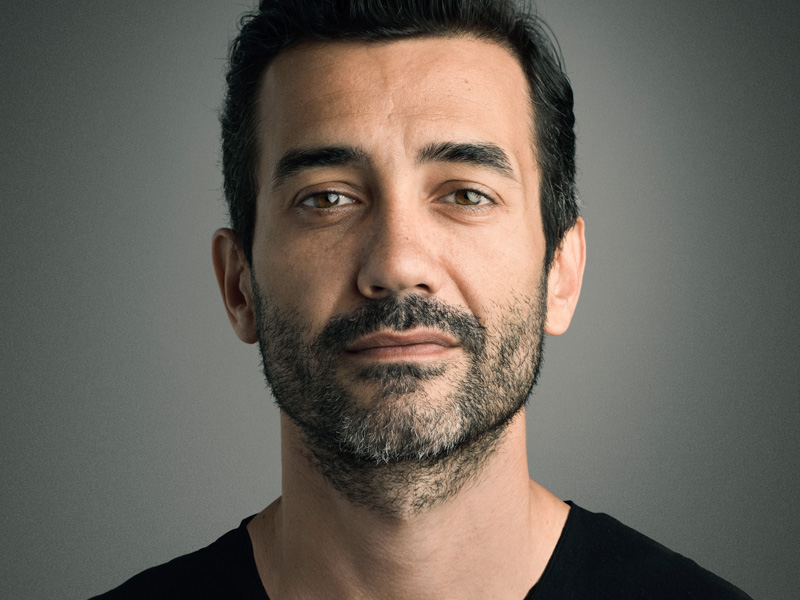
He is doing a job he never dreamed of and even hated once upon a time. It's very interesting but... It does this job very well. How can a person be so good in a field that he hasn't dreamed of, hasn't pursued, and hasn't trained like crazy? Do you call it talent? Perspective? Communication?













To date, he has taken countless interview photos, various project photos, and photographed many famous and infamous models. Fethi Karaduman was most mentioned as Ayşe Arman's interview photographer, and as you know, Arman's interview shots make a lot of talk. In this interview, where we got to know Fethi better, we did not forget to get little tips from him about studio photography and the use of light.
“Communication and Light! That's What It's All About!”
Interview: Nihan Özgen
Photos: Fethi Karaduman
Fethi, can you tell us a little about yourself? When did you start photography?
I was someone who didn't really enjoy photography. They gave me a pen before I even wrote my name, I started drawing and it turned out that I had a talent. I studied primary and secondary school abroad, you know the education systems are different. Therefore, my teachers emphasized this ability of mine. My drawing skills improved even more there.
Then I had to go back to Turkey for high school. When I returned, I was enrolled in the Science and Mathematics department of one of the best high schools in Turkey through horizontal transfer. And I had a hard time there.
Did you continue drawing?
Let me put it this way, everyone has checkered math notebooks... My front two pages are lecture notes, the back 50 pages are drawings... I mean, I used to draw pictures during classes. My teacher took me to the Painting and Sculpture Museum and I took lessons there. Therefore, as someone who draws, taking photographs always felt like getting ready. It was an easy job. For example, a Caravaggio painting is a job that requires much more effort... I have always hated photography, to a certain extent...
So how did you get to that place?
Schools are over, military service is over, I have been a civil servant for about ten years. At that time, something happened to me by chance. A colleague of mine wanted to sell me his analog camera. I have nothing to do with photography either. He said, "You draw pictures but you don't have time. I think you can take very good photographs. Buy it, try it, if you don't like it, return the camera..." So I bought that camera by force. I shot two reels of film. I can say that I started photography the day I developed them. After that, I bought my first camera, the Canon 10D.
Do you have further training in photography?
None. Actually, I'm being sarcastic. I studied architecture abroad. I left it without finishing.
I was wondering, how was your journey in photography? Where did you go?
I tried to discover myself for a year. I found that I focused a little on portraiture. I was unconsciously editing the portrait. With costumes etc. I was constantly trying to tell a story. I took portrait photos at home, with fluorescent lights or by the window, but just because I liked it... Not because I read something and tried it... Then I started visiting blogs on the internet and examining them. Then a friend of mine was following Mehmet (Turgut) very closely, he was his big fan. “Look,” he said, “you take shots like this, but there is also such a man in Turkey…”
Wow!
I studied your work. I liked it very much. The professional version of what I was trying to do at that time was in the studio environment. We went and met with my friend. Our friendship started suddenly.
Did you come to Istanbul from Ankara together?
Mehmet came before me. It was a little difficult for me to leave my job at that time. I've had a two-year wait. Later, I came to Istanbul to Mehmet. We have been working together ever since.
So, have you always worked in the studio? Was there such a decision?
No, the locations are different, but it has always been a fiction. It's different from nature or street photography... Aren't there interventions there too? But there is no turning back from the moment. There is also a bit of luck involved...
I don't think we should call it luck...
No, no, no matter how much you construct it, the moment can change. I have two photos as examples of this. I worked with a model in a project I've been working on for a long time. Her hair and make-up were done. Her clothes and accessories were ready. I took the photo. By the way, a dress in the dressing room caught my attention, it was open-backed. The girl is also very skinny, her ribs are counted. And she moved like a ballerina. We also took a few shots in that dress. That photo won an award at the black and white photography awards. It is now among my favorite photographs. In other words, it was the photograph that developed at that moment, that came to our mind at that moment, that was more impressive than the photograph that I had been working on for years and dreamed of. So it's pure luck.
In fact, thanks to our communication, she gave me more than the pose I wanted. I said stretch your neck, and he stretched it and stretched it. But he removed the vertebrae in his back himself. He noticed what I wanted and gave me that look.
You started taking interview photos from a different perspective. For example, Ayşe Arman is followed a lot, especially because her photos attract a lot of attention.
Yes, that's right. When we looked at the interview photos with Mehmet, we only saw this: Two people drinking coffee, a device in the middle. In fact, every person has a spotlight sentence and a story in their interview. It hurt us that the photo didn't show him. Because the photo also needs to tell something. This is present in Ayşe's interview photos.
But interview photos are generally photos taken by the photographer without knowing the subject, right?
Yes. Beforehand, I learn who I will shoot and the subject. Did he write a book or shoot a movie? Then I picture a shot in my mind and try to take that shot there.
Well, speaking of studio photography, let's say you are going to shoot a celebrity... What is the preparation phase?
I do research on whoever I'm going to shoot. Something comes to mind in my mind. This thing that comes to life could be a costume, a script, an object to be held in one's hand, or a location... Then, I need to explain these to the person I will shoot. He needs to get to know me before telling me. The number one rule in what I do is "communication". So, if you cannot communicate well with the other person, the photo will not appear. He/she may refuse the photo or be shy while posing. To prevent this, we sit down and talk before the shooting. If the person in front of me is relaxed, my job becomes easier.
By the way, talking benefits not only the model but also me. The person you read and research may turn out to be a completely different person when speaking to you. The photo in your head can change shape. Even different ideas may come from the other side. During shooting time, I go down to the studio and shoot.
Do you remember who you drew first?
I shot Nehir Erdoğan for the first Elele Magazine in Istanbul. That was also an interview shoot. It was Ahmet Hakan's interview.
“If there is something more important than the machine, it is the lens and the light”
Can we get some tips from you for studio photography?
Since I usually shoot portraits, I prefer to use 50mm. Or I use 80mm depending on the situation. I don't go beyond these much and I use a non-zoom (fixed) lens. Their lens quality is better and they have less distortion. I don't have a clear preference as a camera. It would be appropriate to shoot with a camera that you can be fast with and that you are familiar with. Even with a mobile phone, I can sometimes capture beautiful shots. It may sound like a cliché, but it's true for me: "The best camera a photographer uses is the one next to him." If there is something more important than the camera, it is the lens and light.
What do you recommend regarding the use of light?
I use filler in exterior shots. Because I like to use natural light. I also use paraflash in the studio. Of course, the angles and dosage of the flash are important. There is no standard light that I use. It may change depending on time and place. I'm constantly experimenting.
While I've found you, let me ask you point by point. What can be shot with flash?
Octagonal flash simulates window light. If you use this light from above, what we call boom, the shadows start to extend downwards. This creates a harsher expression on the face. If you use the light more from the side and with a filler, you will get a softer expression this time. If you shine the same light source from below, the image in horror movies appears. So the angle of the light changes the effect you will get a lot.
Backlight?
If you use backlight, it will give the impression of sitting in front of a window and look more romantic. If you shoot in the same light by changing the exposure, the model becomes a silhouette. Let's say the model is wearing a romantic outfit, shooting with backlight will be very appropriate.
What light can we use to make reverse light?
You can use either a flashlight or a window to create backlight. If the window is open and the light is too harsh, it is necessary to soften it. A tulle curtain will come in handy to soften it. It is also necessary to use foam as a filling so that the model does not turn out dark.
So, when do we make better use of natural light?
There is an hour called golden hour. The hour when the sun is at its best. For example, we shot Tuba Ünsal only in that light.
How to use Ring light?
Ring light gives the same light effect as makeup mirrors. The same effect can be achieved by removing that mirror and replacing it with the camera. The light spreads very neutrally over the model. The face looks smooth as there is no shadow left on the face. The pupil becomes smaller and the eye color becomes more visible. The shadow behind disappears.
What angle should this white foam be?
Angle always makes a difference in the image. If you give the foam from the bottom, you will create a horror movie effect. If you give it from the side, it might look good... If you give it from a little higher, it will be better...
Oh, did you take this book cover too? (At that moment, we see the cover of the book Talk to Your Husband on the screen.)
Yes, I took it. Let me tell you the story briefly: When Şebnem (Burcuoğlu) first came and explained the subject of the book, she said that it was 100% a young Turkish girl's novel. We exchanged ideas for the cover. I reviewed the synopsis, we are meeting again... Then Turkish coffee fortune telling came to my mind. We were all very excited. I said we would place a couple in the coffee fortune telling with Photoshop. We took the silhouette of the couple and buried it in the coffee fortune telling. We weren't supposed to show the hero's face too much. We wanted it to be Şebnem but not be obvious that it was Şebnem. We realized all the ideas and graphic applications. And something very interesting happened that we never expected. People put the cover of the book on their faces and started taking pictures. So, when I was making this frame, I didn't think of anything like "people will hold it like this". That's why this cover is one of my favorite works. Because the project was left entirely to us and eventually went viral.
“If you can get along with the person you are attracted to, then you start to become the person of choice.”
Have you met Şebnem before?
No. But we had good communication while working. I also work a lot with Doğan Kitap. I also work with Fox TV and Hürriyet. I worked a lot not only with Ayşe Arman but also with Sibel Arna at Hürriyet. I am currently working intensively with Ayşe. If you can get along with celebrities, then you are starting to become the preferred person. There needs to be a comfort, a communication. Look again, no matter what we say, communication is the key. If I hadn't established this communication with Şebnem, I wouldn't even be able to picture this photo in my mind.
Do you like traveling?
Of course I love it, but I'm not traveling for photography right now. I go abroad very often for work, but then I take photos with my mobile phone. The moment you capture may be missed until you take out the camera and adjust its settings. In such cases, a mobile phone is a great blessing. Your hobbies change when you switch to professional photography. For example, photography is no longer among my hobbies. (laughing)
Do you have any projects planned soon?
I have a project on fashion called Negative Effects of Fashion (Half Price). The work is not finished yet. Most recently, one of my photographs received an award from Australia. I will turn this project into an exhibition. I plan to donate the income from the exhibition to animal-loving associations and human rights-related organizations in Turkey, such as Peta.
This article was taken from the 20th issue of GezginFoto Magazine.