




















The history of weaving, which has a history of thousands of years, begins with the transition of humans to settled life. With the development of agriculture and animal husbandry, people; learns to spin, dye and weave wool. He takes his greatest inspiration from nature.













Text: Müge ARAL
Photos: Oğuz ÖZDEMİR, Tamer GÜNAL, Tolga SERT
The Turks, who developed kirkit weavings, mastered this art over time, benefiting from the cultural accumulation existing in Anatolia, the cradle of civilizations. So much so that the weaving culture has continued in every corner of Anatolia, unique to every region, and has become famous throughout the world. However, today this tradition is gradually weakening. While once upon a time the sounds of kirkits rose from the village houses, nowadays the carpet looms are put into the warehouses of the houses.
However, Anatolia is not considered dry in carpet and rug weaving. Even though there is a striking decrease compared to the past, weavers and master instructors who are devoted to continuing this tradition do not leave their looms. Filming was done with these people, whom the Istanbul Carpet Exporters Association (IHİB) reached after months of exploratory trips. When the three-part documentary series in which their stories will be screened is completed, the weaving atlas of Anatolia will be revealed.
During this series of long journeys, we, as the shooting team, not only met with the carpet and rug weavers, but also shared the same table with them, listened to their childhood memories, sat together at the loom and learned the story of the rugs they wove. In these lines, I will try to describe some of these artisan artists who continued an ancient culture, transferred social memory to the tapestry they wove with abstractions, and reflected their own feelings in each stitch.
Corn Husk Weaving
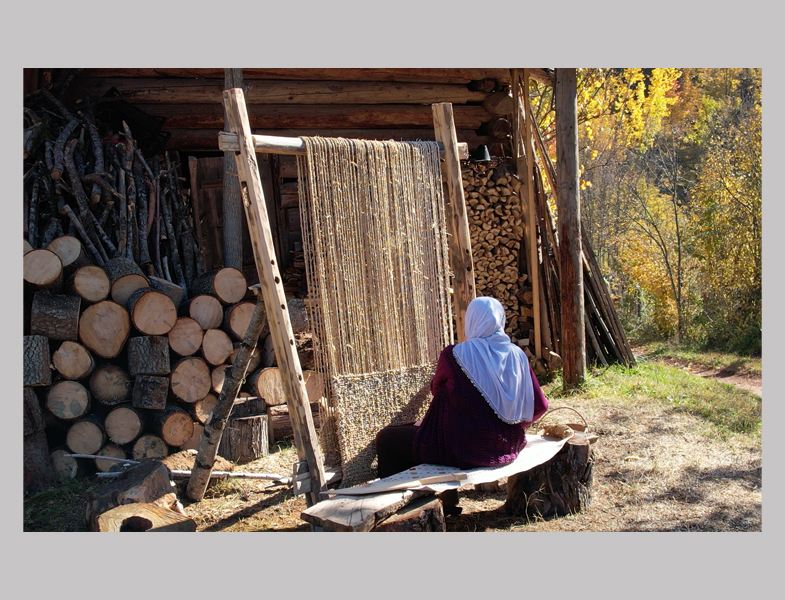
I learned how to weave the wicker mats that we encounter on the beaches in the summer months in Şavşat district of Artvin. Gülnaz Dede, who is a master instructor at the public education center, told us about the weavings of the region and hosted us at her father's house in Çayağzı locality. Fehminaz Gülnaz, who hosted Ahmet Hayri Diler, Bülent Metin, Serra Oruç and the shooting team from İHİB, still continues the weaving that she taught her daughters at a young age. She weaves corn husks on a wooden loom they set up in the garden.
Corn husks are collected to weave this example of vegetable knitting that has survived to the present day. After drying, it is wetted, cut into vertical strips, and then these strips are twisted into rope. In order to weave on the loom, the rope must be prepared in advance. These laborious processes are done faster and more enjoyable by working together.
Fehminaz Gülnaz has been a weaver for years. In the winter months, there are mats, carpets and rugs in their homes; In the spring months, 'cicim' (a flat-woven rug made by squeezing colored pattern threads between the weft threads and creating reliefs on the surface of the weaving) was woven. Gülnaz Dede, who continues her mother's profession and teaches it to those who are willing, is a woman in love with her job. We made friends in Şavşat thanks to Ms. Gülnaz, who impressed us all with her organizational skills, initiative, patience and hospitality. Today, these skilled people, who weave wickerwork to order, keep this art, which has roots in the past, alive, develop it and pass it on to the next generations. These people will shape the future of carpet and rug weaving.
Sarıkeçililer
We found the Sarıkeçililer, one of the nomadic nomads who are frequently featured in the press, in the Konya plateaus at the end of the summer. The family, who spent the summer on a plateau near Tashkent, was counting the days to emigrate.
Hatice and Ali Uçar met Ahmet Diler, Chairman of İHİB Board of Directors, dating back to 1990. In 1990, Ahmet Diler videotaped Hatice Hanım and her young children while talking about the wool sacks and sacks she wove. More than 30 years have passed, but Ms. Hatice still continues weaving. The Uçar couple we chatted with on the Tashkent plateau have a grandchild today. As a requirement of nomadic life, they must move with light items that take up little space. This makes weaving indispensable for them. Ali Uçar, also known as Kuş Ali, says that his children have never been sick during the years they spent in a hair tent. The hair tent that protects them from the cold and wind is also woven by Ms. Hatice. She explains that today, her children prefer to buy ready-made weaving instead of learning it, and that they do not know how to weave because they go to school.
The migration of the Uçar family repeats twice a year. As soon as they start to lift the tent, camels come to them. While Hatice Hanım places the items in the sacks she has woven, Kuş Ali ties these sacks to the camels with hand-woven batans. It takes the family about two hours to pack up and then they hit the road. They will arrive in Mersin after about 40 days and settle down to spend the winter. Then, with spring, the Konya plateaus will wait for them again.
The Rebirth of Silk
Mehmet Ünal is the fourth generation of a sericulture family. As the production manager of the project they wrote together with Bursa Metropolitan Municipality, they revived the Umurbey Silk Production and Design Center, a silk factory established in 1810, and started to train weavers with the carpet workshops they established. It is possible to see the adventure of Bursa silk in the centre, which also serves as the Silk Museum. Mehmet Ünal, as someone who was born into a silk factory, is proud of working to revive silk and sericulture in Bursa. This project, which can revive a lost profession, explain our traditional handicraft to new generations, and enable them to recognize, love and protect this art, has the potential to restore Bursa silk to the value it had in the past. For Mehmet Ünal personally, it means continuing the family tradition.
Mehmet Ünal is so passionate about silk that he shows how to obtain silk thread with an old-style method called recoil catapult. This is the feature of the center... Silk textiles are produced by adhering to old techniques and even by working on patterns that existed in the past.
The production process of silk carpets is much longer than wool carpets. Carpet weaving in Turkey may be far from its old days, but the level of mastery reached by carpet weavers is so high that today, all kinds of images can be woven into silk carpets.
Hereke is one of the centers where silk carpet weaving is alive.In our interview with Nurhan Ör, the representative of a family that has been producing silk carpets for four generations, we learned that Hereke carpets with 400-600 or even 1000 knots per square meter can be woven. Ör, who wove a silk sample of the Pazyryk carpet, which was found in the Altai Mountains by the Russian Archaeologist Rudenko 2500 years ago and is considered the oldest known carpet in the world, also explained the unique patterns and colors of the carpet. The carpet, the original of which is exhibited in the Hermitage Museum today, continues to surprise with its vibrant colors. Studies have revealed that wool that was left to ferment after being dyed was used in the Pazyryk carpet. (See: www.arkeofili.com ) This is an indication of how advanced the weaving and dyeing techniques were in the Iron Age.
In Anatolia, which is located on the migration routes, artisan artists, influenced by their environment, narratives, experiences and outsiders, became the building blocks of an ancient weaving culture. These textiles, which they crowned with improvisations and abstractions, continue to be produced without interruption in some regions today. In some regions, the looms are thrown into the dust of history in the warehouses where they were thrown. This documentary series will remind all of us of an important value that we may have forgotten or perhaps overlooked. Especially if young people learn and recognize these values; That's when he will learn to protect and take care of himself.
İHİB Board Member Serra Oruç
A Short Interview on Anatolian Weaving Tradition
İHİB Board Member Serra Oruç also took part in the documentary shooting, which was carried out with a large team. As the fourth generation representative and business development director of Samur Carpets and Oriental Carpet Market, he talked about the past and present of the weaving tradition in Anatolia and his plans for the future as İHİB.
What can you say if we compare carpet and rug weaving with its past and present?
The first textile findings date back to neolithic times. Carpet and rug weaving is a tradition dating back to ancient times in Anatolia. Especially rugs, floor displays, tents, sacks to store provisions, and different types of weaving to meet a wide variety of needs also appear in ancient times. The tradition of weaving has always existed and continues. With the formation of principalities in Anatolia, followed by empires, the Anatolian Seljuks, the Ottoman Empire and the establishment of the Republic of Türkiye, carpet and rug weaving continues under umbrella organizations.
With the adoption of neo-liberal policies after the 80s, we see that crafts slowed down and weaving went backwards. The closure of these umbrella organizations - one of which was Sümer Halı - led carpet marketers in Turkey to go abroad. We started purchasing from Far Eastern countries such as India, Pakistan, China and Afghanistan. We discovered that the same quality was not achieved even when the products and materials were sent there and tried to be made there. However, since this business did not continue here, even though we could not achieve the same quality, we purchased carpets produced at world standards and marketed them here. However, we came to the conclusion that in order for this work to continue in Turkey, the generation we lost should be brought back. If we can attract the new generation and young designers into this business today, weaving can also be revived. Today, only a very small number of people, and most of them, weave carpets and rugs for their own children's dowry or for their own family's use. Some steps must be taken so that we can return to our old order and restore carpet and rug weaving to its vibrant days in the past.
We can see Turkish carpets in Renaissance Europe in the pictures. Do you think our carpets and rugs, as the product of an ancient tradition, receive the value they deserve in the country? What can be done to increase this value?
I think that carpets and rugs do not receive the value they deserve in the country. This is my 12th year in this industry and since I first started working, I have experienced that the young generation around me is indifferent to carpets. Many of them stated that since I was a carpet maker, they thought of buying carpets when they were going to furnish a house. I think the reason behind this is that this value has been in our country for a very long time, so we have taken it for granted. Since it is no longer spoken about, awareness has also disappeared. Today, many collectors in Europe and the USA are still interested in carpets; symposiums and conferences are organized on this subject; There are special promotions of carpet and rug collections in museums. While these events take place in the West, many Anatolian heritage carpets are kept in warehouses in our country. We don't even have a big museum to exhibit them. I think that we have lost this awareness in other current rushes because we have taken this for granted, like many other values we have. Again, the job falls on the young generation to increase this value. They are the ones who will keep this going. This transfer must be ensured. This could perhaps be done in collaboration with an artist or designer; This issue can be discussed and brought to the agenda again by collaborating with different disciplines.
In fact, all the works produced throughout history; It could be an architectural work, it could be pottery, it could be a mosaic, they all spoke in a similar language and reflected the design language of the same period. Today, we are actually trying to get inspired by researching some rising values and trends adopted in the world via the internet, but what the Western world actually does is to take inspiration from historically rich countries like ours and produce collections. We are trying to get inspired again by what they produce. In order to raise awareness on this issue, both printed and oral publications need to be increased. At the very least, it can serve as a resource for people researching these issues. This issue may affect different disciplines and an area of interaction may arise and this value may begin to be discussed again.
Bottom row from left to right - Ahmet Çelik, Muharrem Kara, Mustafa Adnan İlhan, Levent Yılmaz, Uğur Uysal, Serra Oruç, Ahmet Hayri Diler, Erdal Oruç, İbrahim Geyikoğlu, Mustafa Kayhan, Abdülkadir Sarım, Nihat Yıldız
Top row from left to right - Erdal Baş, Abdullah İslam, Bülent Metin, Haşim Güreli, Muhammed Bedir, Faik Topak, Muhammet Solak, Ertuğrul Başdoğan, Nurullah Yörük, Kadir Söylemez, Hasan Altuntaş
The changing age and accelerating time have removed hand-woven carpets and rugs from our lives. This caused the number of weavers to decrease. What does this documentary series mean to you as İHİB? What are your goals?
Of course, there is an order dictated by the changing era, technology and the world. It is out of the question for us not to keep up with this. While the number of hand weavers is decreasing, machine-made carpet production is increasing very rapidly, especially in Turkey. Türkiye is known as the country of carpets and we have an important share in the world in the machine-made carpet trade with the factories built on this heritage and experience. We have a say in this matter. We cannot ignore this, but a craft and such an old tradition can continue in a very niche way. It can continue with personalized productions, location-specific applications, both as a work of art, hanging on the walls in more abstract forms today, just as it did in the past, and also with boutique productions.
We had two goals when we started shooting this documentary. The first is to transfer this tradition to the new generation and leave an oral source, an archive. Türkiye, as I said, is the country of carpets... But since such a comprehensive study has not been done before, the researcher cannot actually access many sources on the subject. We thought that this study would fill this gap because we live in a visual age. We thought that if we could explain Anatolian weaving, Anatolian life, Anatolian people, we would help remember some values and pass this archive on to the next generation.
Another goal of ours is to export the value here abroad. Turkish carpets are currently very valuable in many markets. If we arouse that interest there again, we can revive production here. We thought we could cause a movement both inside and outside. In fact, the most preferred form of marketing today is stories. The Western world does this very well. Stories sell. We have so many stories that we sometimes ignore them. We aimed to revive the story of Anatolia, transform it into a valuable product for the relevant people, and actually export a culture. If we can introduce our own culture, this can turn into a carpet or another work of art... We believed that we could create this value again, both in the eyes of people and economically.