



















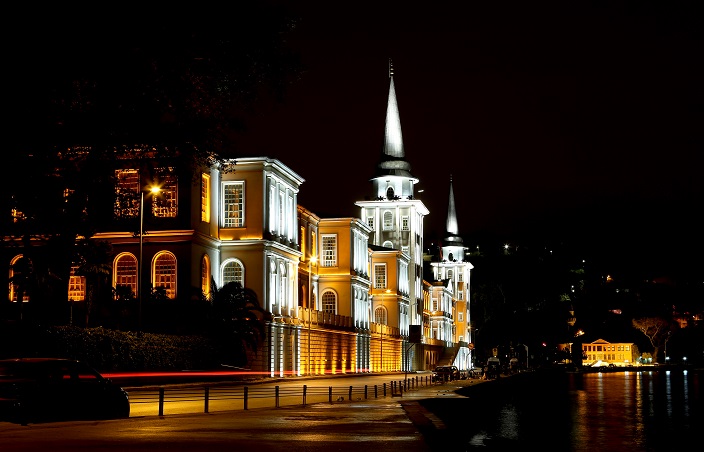
Taking photographs with the long exposure method means photographing the flow of time, not a single moment.













This method will give you the opportunity to tell stories that are so realistic that they can be said to be moving, instead of a frozen frame.
Text and Photos: Adem MELEKE
1-DISCOVER THE SKY
In order to take a long exposure, you must first know what light your place will give at what time. Generally speaking, the sky will be yellow-blue at sunrise, red at sunset, blue for an hour or two after sunset, and black at night. You should definitely take these factors into consideration in environments with external light sources and on full moon nights.
During long exposures at sunrise and sunset, if your direction is towards the sunrise or sunset, your exposure time will be considerably shorter. And your color transition will be yellow-white-blue-black from bottom to top at sunrise. At sunset it will be red-blue-black. If you expose with the sun behind you at these times, your exposure time will be longer and your color transition will be blue-black from top to bottom.
If you are going to expose after sunset, your aperture and shutter speed will depend entirely on the external lights around you. Here you can use all aperture ranges according to your composition for impressive frames.
Long exposure during the day or in artificial light has variables depending on the location you will photograph. Clouds or branches swinging in the wind will create blunt areas for you. Blurring a part of the photo in these photos will allow you to demonstrate an artistic technique.
2-FIX YOUR MACHINE
The easiest way to do this is to use a tripod. If you do not have a tripod, you can place your camera on a wall, table or car. Don't even consider shooting handheld unless you have a superpower that can stop your pulse and all your involuntary muscles.
3-DELAY
Pressing the shutter button will definitely cause vibration, so use an external trigger for long exposures. If you do not have a trigger, use the delayed shutter release option on your camera. Many cameras have a 2-second or 10-second delayed shutter feature.
4-FOCUS MANUAL
During long exposures, be sure to focus manually as movements that may occur during the exposure time will change your focus point. Remember, the points closest to you in the frame will be outside your focus area, so determine your focus point accordingly.
5-VIBRATION AMPLIFIERS
Be sure to turn off the anti-vibration feature of your lens. If you do not take this action, which may seem contrary to your logic at first glance, you will lose clarity. Why? The anti-vibration feature in the lenses automatically predicts that you will press the shutter button and predicts that the camera will fall forward and applies a backward balancing movement thanks to the micromotor. However, since your camera will be stationary and you will use a trigger or delayed shutter release, this vibration will not occur. If your machine has a vibration suppressor, be sure to turn it on. Since these systems work with the help of stabilizers, they will absorb vibrations caused by wind or the ground (such as a car passing).
6-LENS SELECTION
Although it is believed that prime lenses always give more artistic results for long exposures, I do not think this is very valid. Well, a quality zoom lens can also give you great photos. The only thing you need to pay attention to is that if you are shooting with a wide angle lens, you should know the distortion rate and create a frame that you will crop from there...
7-FILTER
Especially ND filters add a wonderful fairytale to your long exposure photos. The ability of these ND filters to make the water look like cotton in your waterfall during the day or sea photos at night and prevent the light from bursting. You can also use UV filters during daytime exposures, thus obtaining light beams.
Note: Light painting technique was used in this photo. For this reason, it is completely outside the aperture ranges we gave above.
8-WIDE VIEW
Since any movement will be reflected in your frame during long exposure, prefer compositions with wide angles and depth as much as possible. In narrow and cramped compositions, possible vibrations and particles in the air will spoil your photo. Of course, the opposite of this suggestion can also give you very special artistic shots in various weather conditions.
Star exposure and light painting with the long exposure technique will allow you to take the most familiar and artistic shots. We have included very technical articles by our esteemed authors in previous issues regarding these techniques. We will explain it with a short road map like this again in the coming issues.
May you have plenty of light...