



















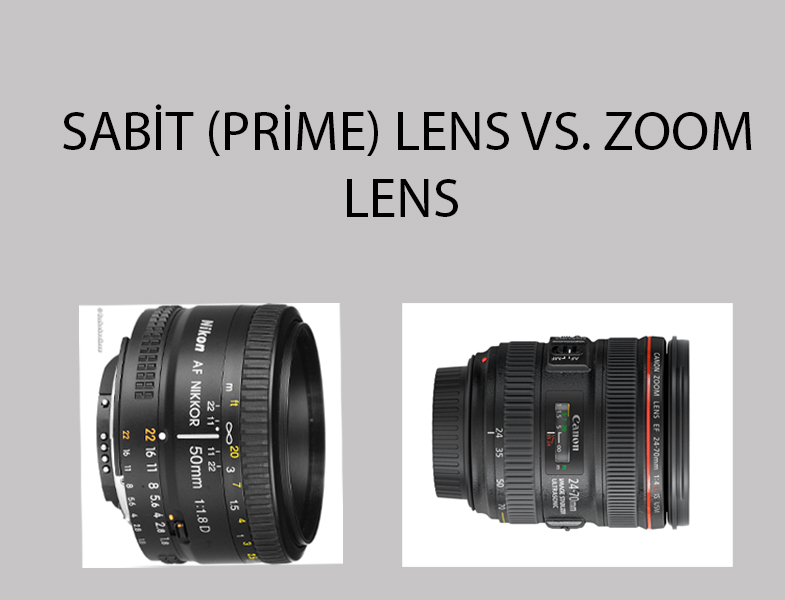
A widely discussed issue in our photography world is whether to use a fixed lens or a zoom lens. The answer to this question will definitely depend on your field of photography and style. The needs of a landscape photographer, portrait photographer and street photographer may be different. After explaining which lens works and how it works, you decide which lens you should choose.













Text and Photos: Yüksel ALTUN
There are many lenses in photography, the focal length of the lens is decisive. Accordingly, 5 separate categories can be made:
- Very wide angle - Full frame 12-24mm and below / Cropped 10-20mm
- Wide angle – Full frame 24 – 35 mm / Cropped 18-35 mm
- Standard – Full frame 35-70 mm / Cropped 24-50 mm
- Standard tele – Full frame 70-135 mm / Cropped 55-105 mm
- Tele – Full frame 135 mm above / Cropped 105 mm and above
Considering these focal ranges, 24-70 mm for full frame and 18-55 mm for cropped cameras are the most commonly used lenses.
Krop Factor
Today's digital cameras have a light-sensitive surface called a sensor instead of film, and the image is formed here. The size of the sensor explains the concept of full frame / crop.
Full frame means film size sensor: 36 x 24 mm (35 mm film size). Nikon crop sensor size: 24 x 16. As you can see, there is a difference of 1.5 times, that is, it is smaller. The crop factor varies depending on the features of the camera. Canon's crop factor is 1.6.
As seen in the figure, the crop factor angle is narrower. This leads to the following result: For example, if you have a 12-24 mm wide angle lens, we frame it as 12-24 mm with a Nikon full frame camera. If we have a camera with a Nikon crown, we multiply the focal range by 1.5, which gives us the result of 18-36 mm.
Even though we lose the wide angle here, we can zoom further with 36 mm. Cropped camera lenses; It is lighter and cheaper. Since the middle part of the lens is used, there is less vignetting and photo sharpness is good.
Prime (Prime) Lenses
Prime – Prime lenses, also called prime, are lenses with a fixed focal length that you cannot change. The most commonly used one is 50 mm. The use of these lenses provides the following advantages:
- Weight – Much lighter than zoom lenses.
- Maximum aperture range – Aperture down to F1 provides light and shallow depth of field.
- Composition – More effective compositions can be created with narrow and simple frames.
Prime lenses have fixed focus and aperture. Since there is no zoom ring, there is no choice but to move closer to magnify the object.
When to Use Prime Lens?
Some shooting areas and techniques that affect our choice of fixed lenses can be listed as follows:
Portrait photography – Clarity of the model and control of the background are very important in both studio and outdoor shooting. Using an open aperture here provides advantages in terms of background arrangement and lighting. 50 mm or 85 mm F1.4-1.8 are the most preferred lenses.
Street photography – The most commonly used lens is 50mm. This is due to close focus to what we see and control of low light conditions. 35 mm can be used for machines with cuffs.
Low light – A tripod may be preferred for long exposures when the light is low. However, if the subject is moving and sharpness is desired, a fast prime lens and open aperture should be used. Think of a festival held at night, the best lens here will be a prime lens.
Making bokeh – The best bokeh is achieved with a prime lens and open aperture.
Nikon-50mm-F2-E50-ISO2000
Nikon-50mm-F2-E60-ISO2000
Zoom Lenses
In addition to the advantages of fixed lenses, zoom lenses will also provide advantages depending on the shooting area and style.
- Quick framing change – Allows quick focal length change.
- Weight – Heavier than prime lenses. Some like it heavy. J.
- Aperture – The best zoom lenses have apertures up to F2.8.
In zoom lenses, variable focal length and aperture can be fixed or intermittent.
When to Use Zoom Lens?
With the ability to change focal length, it can be used in many types of photography.
Event photography – In events and organizations (Wedding, engagement, meeting…)
Sports photography – Remote with Tele, varifocal and F2.8 are important for light.
Travel photography -Travel photography is the field where all lens ranges may be needed. There is limited space in our bag. A lightweight F4 lens with a different focal length can be used here. The commonly used range is 18-200 mm.
Zoom in and out – When you want to use this technique you need to have the appropriate zoom lens.
Nikon-200mm-F16-E6sn-ISO200-tele
Prime Lens vs Zoom Lens
Most photographers are forced to choose between lightweight prime lenses with wide apertures or more versatile zoom lenses that allow you to change the focal length but are often heavy to carry.
Which one is your choice?
Prime lenses and zoom lenses have their pros and cons, but for some photographers, prime lenses will provide the advantage, sharpness. Let's take a look at these photographers and the lenses they use.
- Wedding photographer - The best lens would be a 24-70mm zoom lens with F2.8 aperture.These focal lengths will cover just about anything you need to photograph.A wide-angle zoom is also worth carrying.Sometimes there may be time for a wedding day portrait session, so a prime lens, perhaps an 85MM f1.4 is a good idea.
- Street photographer - 50mm F1.8 is a great lens, but if you have more money get the F1.4 or F1.2.Alternatively the 135mm F2 also works very well.
- Travel photographer - Use a wide-angle zoom for most travel situations and F4 for lighter weight.A good prime lens like 50mm is a good choice for photographing people on the street.If you are going to photograph a festival, you will need a telephoto zoom.
- Landscape photographer - A wide-angle lens is a must, be it zoom or fixed... If you like photographing the Milky Way, you need an aperture of at least F2.8.However, if you get a wide-angle prime lens, you can get even larger apertures and this will help you do astrophotography.
Olympus-34mm-F8-E40-ISO100
Olympus-300mm-F8-E60-ISO200
5 Reasons to Use Fixed Lenses
1-Composition:
Using a prime lens encourages us to envision the composition within the constraints of focal length. The argument against zoom lenses is that they make the photographer lazy. With fixed lenses, you are ready to shoot before you bring the camera to your eye. The more you get used to using a single focal length, the faster you can visualize your final shot by looking at the scene, without the camera with your eyes.
2-Light:
Prime lenses generally have wider maximum apertures. Pressing the shutter release lets in more light, which means you can expose in low light conditions without increasing your ISO or slowing down your shutter speed. Lower ISO means clearer images and faster shutter speed improves sharpness.
3-Depth of Field:
Depth of field refers to the clear area in our image. Prime lenses have a wider maximum aperture, providing a shallower depth of field. F1.4 aperture will provide less clear area and blur (bokeh) effect than F2.8.
The ability to blur the area both in front of and behind your subject using a wide aperture helps separate your subject from other elements in the photo.The subject becomes more prominent.
4-Dimension – Weight:
Prime lenses are generally lighter than zoom lenses. It is important to note that prime lenses do not necessarily have to be small and light. In fact, many fast prime lenses are quite large and heavy. Similarly, there are many small and lightweight zoom lenses with lower glass quality and higher apertures.
5-Image Quality-Sharpness
Image quality and sharpness is higher in prime lenses. Traditionally, prime lenses are known for their advanced optics and quality.They generally have fewer moving parts, so manufacturers can focus their efforts on adding quality glass and mechanisms. However, high sharpness can also be achieved with zoom lenses with fixed apertures. The advantage of prime lenses is their price.
So, Why is Zoom Lens Preferred?
1-Portability
Instead of carrying prime lenses with different focal lengths, we may need a zoom lens with the same range. Additionally, not changing lenses frequently reduces the risk of dust on the sensor.
2-Price
Although fixed lenses are more affordable, purchasing more than one lens will increase the cost compared to zoom lenses.
3-Flexibility
Perhaps the biggest advantage to zoom lenses is the flexibility they offer a photographer. Zoom lenses provide someone who wants to shoot at a variety of focal lengths with the ability to quickly change perspective and complete their shot in seconds with a quick zoom.
Nikon-12mm-F11-E125-ISO200-genisaci12
Factors That May Affect Your Decision When Purchasing Lenses
Budget is Important
The budget we will allocate for photography and photography equipment is important. For low budgets, lens reviews should be followed. Those with a high price-quality ratio may be preferred.
APS-C or Full Frame
Although purchasing a full-frame lens when you have an APS-C camera may be a disadvantage in terms of focal range, it may be a good investment for your next camera.
Pay Attention to Focal Length
Prioritizing the focal length you need will provide the best lens solution for your budget. Prioritize and get what you need. For example, you have a lens in a normal focal range (such as 24-70mm - 18-55mm - 18-105mm). Do you primarily need a wide angle or tele lens? Prioritize one and stretch your budget.
Which Subjects Will Be Photographed?
Make your choice of fixed or zoom lenses according to the subjects you will shoot. Zoom lenses are preferred for sports or landscape photography. Fixed lenses will be advantageous for macro or portrait shots.
Weight and Dimension
In this regard, there may be differences between the types of lenses, as well as differences according to the features of the cameras (DSLR / Mirrorless). It is worth examining.
Quality, Durability and Speed
Lens sharpness quality, resistance to harsh conditions (Plastic, Magnesium body…) and focusing speed of the lens are important. Look for answers to these questions when purchasing.
Brand or Other 3rd Party Lenses?
While brand lenses can be purchased, lenses of alternative brands with higher efficiency at more affordable prices (such as Sigma, Tamron) can also be preferred.
A Reminder About Lenses
As you may remember from previous issues, there are good or poor apertures and focus ranges for each lens. Every lens has an aperture range at which it is sharper. This is determined by MTF tests as mentioned above. In general, the most ideal sharpness is achieved between F8-16. Shooting 1-2 stops below the lens at its lowest F value will affect sharpness.
Zoom lenses have a focal length called "good range". Good range is the focal lengths at which the lens is sharpest. For example, the good range of a 24-70mm lens may be 35-60mm as a result of testing.
For all these features, it is useful to examine the reviews and tests before purchasing the lens.
Sharpness and Lens Tests Sharpness and speed are among the most important criteria in lenses. Three different tests are applied to lenses according to standard testing guidelines:
1- MTF test consisting of quadrants located in the center and at the borders: It is the sharpness test.
2-Grid diagram for distortion tests: It is a problem experienced in wide angle lenses.
3-Plain white table for vignetting tests: Occurs in wide angle lenses.