



















“For me, art is universal, it is the common language of the world. That's why local colors do not concern me...
If I am going to make films based on national values, and if theaters must make national theater, we cannot go further than Hacivat and Karagöz, Ortaoyunu, and the mehter band.”
Şahin KAYGUN













Text: Assoc.Prof.Dr. A. Beyhan ÖZDEMİR @beyhanozdemir51
Dokuz Eylül University Faculty of Fine Arts
Faculty Member of the Department of Photography
Şahin Kaygun is an artist who started photography by taking photographs of his English teacher, his close friends and siblings, with whom he fell in love in his childhood, and was first interested in his own environment, and throughout his life he always adhered to the factors that his environment inspired him. He created works by transforming what he saw at the level of the visual possibilities of photography and subjecting it to aesthetic processes with some technical and ideological interventions. He did not see photography as a mechanical process, but perceived it as an activity most prone to integration with other branches of art. Kaygun quickly began to show with his works that he is a researcher, experimenter and meticulous artist with a personality that is open to innovations.
There is a relationship between all arts, and different techniques affect the development of these arts, their creations and the connections between them. The combination of arts has an important place in Şahin Kaygun's works. There is a lot of use of visual arts in the understanding of photography. Evaluating the structure and stage lighting of the plays with the eyes of a graphic artist, he produced photographs with predominant graphic effects, taking advantage of the conflict of "black and white". Even as theater photographs bring up the problems of theater in their works, they are imaginative, fantastic and very visual with their descriptive narrative. He symbolized the visuality of stage art with the supernatural concepts in his memory. When we look at Kaygun's works, we see that the boundaries between the branches of art are beginning to disappear, new art fields are emerging, and he emphasizes that this is a phase of the development of contemporary art, and that he wants to exceed the limits of technical possibilities as well as expression possibilities. Therefore, it adds different materials to the photograph. He uses techniques such as erasing, scraping, painting, collage and photomontage in his photographic works. In fact, after "taking" photographs for a while, Kaygun created his own unique style and started "making" photographs.
Şahin Kaygun's photographic works, which have a history and experience of approximately 30 years, should be evaluated in 5 different periods. When examined chronologically; "Photographs of Soldiers and Workers" It is possible to collect and under the headings “Photo-Peinture Works” .
Visualization of “Thought”: Photographs of Soldiers and Workers
The 1970s were the years when photography problems were discussed on a discussion level in Turkey. At that time, the organizational effort, which had generally shown regional and amateur characteristics until then, began to gain a certain momentum with "FOTOS", of which Şahin Kaygun was among the founders. FOTOS was founded in 1977. The first collective exhibition of the association included the subject of "Loneliness". Şahin Kaygun participated in this exhibition with his military photographs, and thus, after the first attempts, which showed that he was in a quest with the exhibitions he opened outside Istanbul until the 1970s, he revealed that his option was to master photography. The "Soldier" photographs in the FOTOS exhibition generally depict soldiers resting with their weapons drawn after a training session. This series, which covers all the contextual elements of a human landscape, also brings forward a humanistic message. Even if he is among the masses, man is limited to the periphery of his own world. This truth is clearly reflected by the soldiers' attitudes as well as their looks fixed on the camera. There is a hidden portrait concern and search in these photographs of Şahin Kaygun.
Anatolian photographs generally appear to be portrait-oriented. The world outside the portrait, which looks like a curtain stretched behind, hides everything that is intended to be told in the best possible way. In a sense, this is considered an extension of Şahin Kaygun's expressive attitude. Şahin Kaygun produced photographs of soldiers and workers, images of Anatolia and his later impressions of Salzburg, with a method parallel to the ordinary and known use of photography, that is, within the rules of "straight photography". However, instead of detecting and reflecting any interesting event or image in these photographs, he visualized a "thought" that would allow the viewer to find it in those photographs.
Kaygun's research on the "level of consciousness that transcends randomness" began with his trip to Salzburg in 1980, and he opened the first exhibition of the period in Ankara in January 1982. The first striking feature of the photographs he exhibits is that they have an open-ended structure that gives the impression of being unfinished. Mostly photographs contain meaningful symbols scattered in various natural environments. What is in question is the resistance fused with the contradictions contained in the idea of death and life, which are an integral part of human nature. Kaygun attempts to use "death" in his themes. It deals with the concepts of "life" and "death", two indispensable elements of human nature, in philosophical dimensions. The "dead bird" series in his works in Salzburg is evaluated in the death-human-life triangle. In his photographs in this series, he uses symbols, which are the first examples of symbolic expression in his later works.
The Quest to Decide the Language of Photography: Graphical, “White” or “Black” Photographs
Şahin Kaygun's graphics education played a major role in his approach to photography with different approaches. Because graphics is a field of study that envisages the pluralistic structure of design and aims to spread creative activity on a plane that includes the use of all kinds of materials, tools and equipment. In this field, Kaygun was in favor of including "worlds" in photography that only he could create. That's why he was in and at the forefront of every innovative movement. Based on known simple techniques, he wanted to try other forms of expression other than pure photography. For this purpose, he chose large spaces as his space and established the balances he wanted by placing his figures in these empty spaces. It presented a unique world within a graphical framework by simplifying concepts such as space, time and dimension as much as possible. The works of this period can be classified as "white photographs" and "black photographs". “White photos”; can be seen as products of graphic editing concerns. The figures placed at corners of a snow-covered landscape that stretches as far as the eye can see are impressive enough to bring to mind the visual phenomenon of photography. The series of “black photographs” constitute the opposite aspect of the same activity. Photographs of this type have a special place in terms of a hand movement, a facial detail, a body bending, where the light falls on a surface that covers a large part of the photographic frame, the minimized form of the activity that can be expected from the lens, and the fact that they push the limits of visual value to the utmost. Without concentrating too much on his early work on examples of graphical painting, he turned to the effort of analyzing the narrative language of photography, and by the 1980s, he had reached a stage of researching the harmonious movements of the human body accompanied by light effects.
Kaygun calls the photographs of this period, which contain a truly "purist" approach, "black" photographs, because the black tone predominates in the photographic frame. In these photographs, where the light reveals the details and curves of the human body on a black background and suggests, at first glance, that a photographic abstraction aesthetic is intended, an attempt is made to give the effect of color transitions between opposing tones of black/white. Expressive elements are highlighted with emphasis on tone. There is a physical mise-en-scène arranged with light and light effects. In addition to his investigative and enterprising attitude, Kaygun, who does not like to stick to rules and therefore does unconventional works, has also gained importance with his expressionist works in which he supports fantastic elements with graphic expressions.
The Multifaceted World of Human Phenomenon: “People of Art”
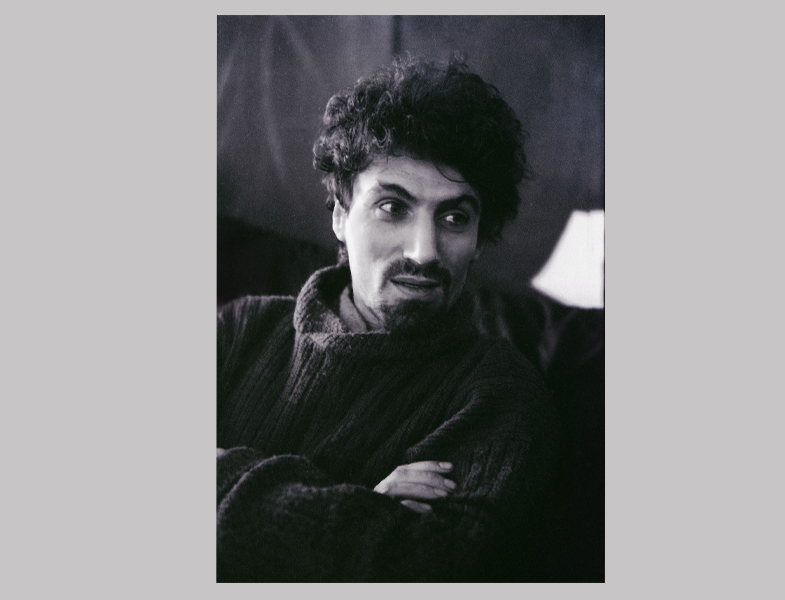
Our portrait photographers have made significant progress in analyzing the complex structure of the multifaceted world of human phenomena, with its intertwined problems, and expressing it with an effective understanding of form. In the unearthed works, typography, light, color, tone transitions, framing, stacking, part/whole relationship, atmosphere creation and self-form weave have reached an impressive level. The stylistic distinction, which we can describe as personal concentration, has begun to gain sharpness. In Şahin Kaygun's portrait photographs, all the features mentioned above are seen at a level that can be called perfect and flawless. In his photography series called "People of Art", Şahin Kaygun does not give the usual portraits of people who are integrated with art and culture. These are not people "posing" in front of him, but "ordinary" beings who stand without posing and reflect the traces of their natural lives, their worlds of emotions and thoughts. It's as if these artistic people open the doors of a new world.
He took portraits of approximately 400 artists in his work "Art People", which always aims to reflect the artists in their own worlds or the worlds they create in their works. Many famous foreign artists such as Herbert von Karajan, Elia Kazan, Anne-Sophie Mutter and Wim Wenders also took part in this series. He used light, graphic expression, artists' expressions and features perfectly in technical and aesthetic terms in photographs and revealed the language of photography with his unique expression. For example; Portraits of artists from different branches of art such as Bedia Muvahhit, Füruzan, Füreya and Attila İlhan, reflecting a natural, simple and mysterious atmosphere, with technically perfect light and tone transitions, as well as Mahmut Cuda, Fazıl Hüsnü Dağlarca, Tomris Uyar, Salah Birsel, Adalet Ağaoğlu, Timur Selçuk, Ara Güler, Turhan Selçuk, Avni Arbaş, Burhan Uygur, Ferruh Doğan, etc. He captured many artists in their ordinary lives. When looking at these photographs, it is possible to see their own art environment, mysterious world, and personality reflections.
Şahin Kaygun's photographs are not photographs of memories or documents. Even the “People of Art” photo series is not a “documentary” in this sense. These works aim to find the mysterious meaning in a person's face and gestures and directly explore human reality. Deepening meaning relationships has become the artist's basic tool. When the photographs are evaluated not one by one but as a whole, the details that bring reality to light are resolved one by one. His work "Art People" is a result of the artist's responsibility to witness the period in which he lives. The portraits taken by Nadar in the early years of photography created a cultural portrait of Europe in the 19th century. Şahin Kaygun's "People of Art" almost created an artistic portrait of Turkey in the 20th century.
The Great Success of “Small” Photography: Polaroid Photos
Şahin Kaygun stated that he did not "take" photographs, he "made" photographs. According to him, photography; It is an area where the possibilities of transforming the ready image presented by the machine into a personal vision are researched. Intervention or modification, which is common in art, is well reflected in Kaygun's photographs. He also applied unlimited intervention methods in his works, which is why the Polaroid photographs he made in the late 1980s and the painting-photography combination Photo-paintings he exhibited in the early 1990s created great controversy. Since 1980, the expression styles and techniques used by Şahin Kaygun in his photographs have changed greatly. This change is seen in important points such as photographic language, interpretation and theme, as well as in the forms of expression. He started his first serious experiments and works with polaroid material in these years and exhibited his polaroid works in early 1984. Polaroid works, which had not been tried before in Turkey, attracted great attention, but also caused controversy and were described as a deviation from photography. Peter K. Eichorn, Vice President of the Polaroid company, who came from the USA, also watched the Polaroid exhibition and described the works as "important artistic contributions made on Polaroid" and emphasized that he was not a slave to the technique he used, on the contrary, he dominated the technique and produced works of art by taking advantage of it and using the technique.
The works proving that Polaroid gained a personal visual quality through external interventions surprised those who had despised this genre until then. Polaroid photography, defined as a type of "instant" photograph and thought to have no value beyond simply responding to a rush photograph demand, has gained a new meaning in the master hands of Şahin Kaygun.
“In the Old Time Seas”: Photo-Peinture Works
Continuing his search and experimentation in photography, Kaygun turns to different materials. First, he does color research on black/white photographs. He tries to color his black/white photographs with colorant baths (toner). It eliminates unwanted details in the photo by erasing or scraping them. He places the details he wants wherever he wants. He paints on photographs using acrylic paint. When Kaygun's collages, fantastic fictions and symbolic expressions come together with this simple and well-known technical method, works that are a mixture of painting and photography emerge.
Photo-paintings were created entirely using photographic techniques. Most of the visual elements used are human torsos, dolls, seashells, sculptures, etc. always in photographic appearances. With his photo-painting works, Kaygun strives to rearrange the world of emotions and thoughts with a surrealist approach on his own platform. Şahin Kaygun created a new surprise and controversy in the photography and other art circles of our country with his photography series called "Old Time Seas", just like his polaroid works. This series of photographs consisted of photo-paintings in which he made “painting on photography” or “photography on painting”. The issue of whether these works, in which painting and photography are considered as complementary and mutually supporting formations, are paintings or photographs, has been discussed in art circles for a while. However, for Kaygun's works, the question "photography or painting?" Asking and discussing such questions is unnecessary and very wrong. Because it is very wrong and an injustice to that artist to discuss the creativity of someone who does this work, which presents different branches of art as an intertwined, harmonious bundle, with great passion, avoiding all conveniences, without hesitation to question himself at any time, and with care and devotion.
Kaygun, who is careful not to repeat himself, questions hypocrisy, plural loneliness and fossilization, which are among the predicaments of humanity, with poetic automatism in his latest works. According to him, the works in question are "bringing together the language of painting and photography at a contemporary point." To summarize his recent works in one sentence: It is possible to say that it is "the investigation of the timeless third dimension of reality through dreams". This attitude also keeps alive the passion for examining the difference between "taking photographs" and "making photographs". Şahin Kaygun has a special place and importance in Turkish photography, especially in terms of his photographic works in the last years of his life and the diversity of his artistic direction. He is a versatile artist who constantly experiments, researches, creates different and unconventional products, renews himself and surpasses himself. His mature works, which he revealed in his photo-paintings titled "In the Seas of Old Time", are truly an understanding of metalanguage. Many other photo-painting works such as “Notes from a Photographer's Diary”, “The Devil's Spears”, “In the Loneliness of the Night”, “Accompaniment of Tired Dems”, “A Strange Day”, “The Man Waiting at the Wrong Stop”, “The Fairytale Horse of the Blue”, “The Blue-Haired Boy”, “On the Border of Lost Time”, “The Daughter of Old Waters”, “Images in Search of Their Voice”, They are large format works of the artist, each of which is a long film story or mysterious and imaginative. The main material of these works is photography. Because he used film and photographic paper, and applied bathing and enlargement in the dark room. His works made with this method should be considered as "photo-paintings" instead of calling them photographs or paintings.
Şahin Kaygun, who applied many technical and aesthetic interventions to his photographs such as photomontage technique, scraping and painting method, collage, painting on photographic images, preferred to "create" rather than "reflect" external realities with an artistic sense of form within the unlimited possibilities of creativity. Thus, he achieved an original language synthesis and created a system of words that is open to interpretation and enables endless interpretation possibilities. He is an artist who pushes the possibilities of imagination and fiction within his own nature and concretizes them at the level of thought. By reflecting a world of his own, he completely departed from the documentary-realist or street photography approach to which almost all photographers of his time turned. In summary, Kaygun, who created a contemporary and interdisciplinary language by blending art fields such as photography, painting, graphics and cinema, has shown that he is one of the avant-garde names of Turkish photography. Şahin Kaygun is one of the versatile artists of the 1990s who won the struggle of "individuality" and "being a school in itself" long ago.
RESOURCES USED
1) A.Beyhan Özdemir, “The Problem of Intervention in the Context of the Evolution of Photographic Language”, Unpublished Doctoral Thesis, DEÜ SBE, 1996, İzmir
2)Kaya Özsezgin, “Şahin Kaygun: A Short Life Dedicated to the Cliffs”, Art in Turkey, Plastic Arts Magazine, May-August 1993, Istanbul
3) Kaya Özsezgin, “From Purism to Experimentalism”, Notes from a Photographer's Diary, Promat A.Ş., Istanbul, 1992
4) Seyit Ali Ak, “Portrait Tradition in Turkish Photography”, Refo Photography Art Magazine, April-June 1991, Issue: 20/21
5) Şahin Kaygun, Notes from a Photographer's Diary, Promat A.Ş., Istanbul, 1992
6) A.Beyhan Özdemir's interview with Şahin Kaygun on 31.01.1991